Recurring Pain After Meals
Steady right-upper or upper-middle abdominal pain after eating may reflect biliary colic.
- Share when the problem started
- Bring prior testing and treatment details

 Medically Reviewed by
Dr. Bharat Pothuri, MD, FACG
| Updated 07-14-2026
Get patient-focused guidance for symptomatic gallstones, right-upper abdominal pain, ultrasound findings, bile-duct obstruction, pancreatitis risk, ERCP, and surgical coordination. GastroDoxs helps you understand testing, treatment choices, warning signs, and the next step.
GastroDoxs GutRescue Mission™ helps patients move from uncertainty to a practical plan for symptomatic gallstones, right-upper abdominal pain, ultrasound findings, bile-duct obstruction, pancreatitis risk, ERCP, and surgical coordination.
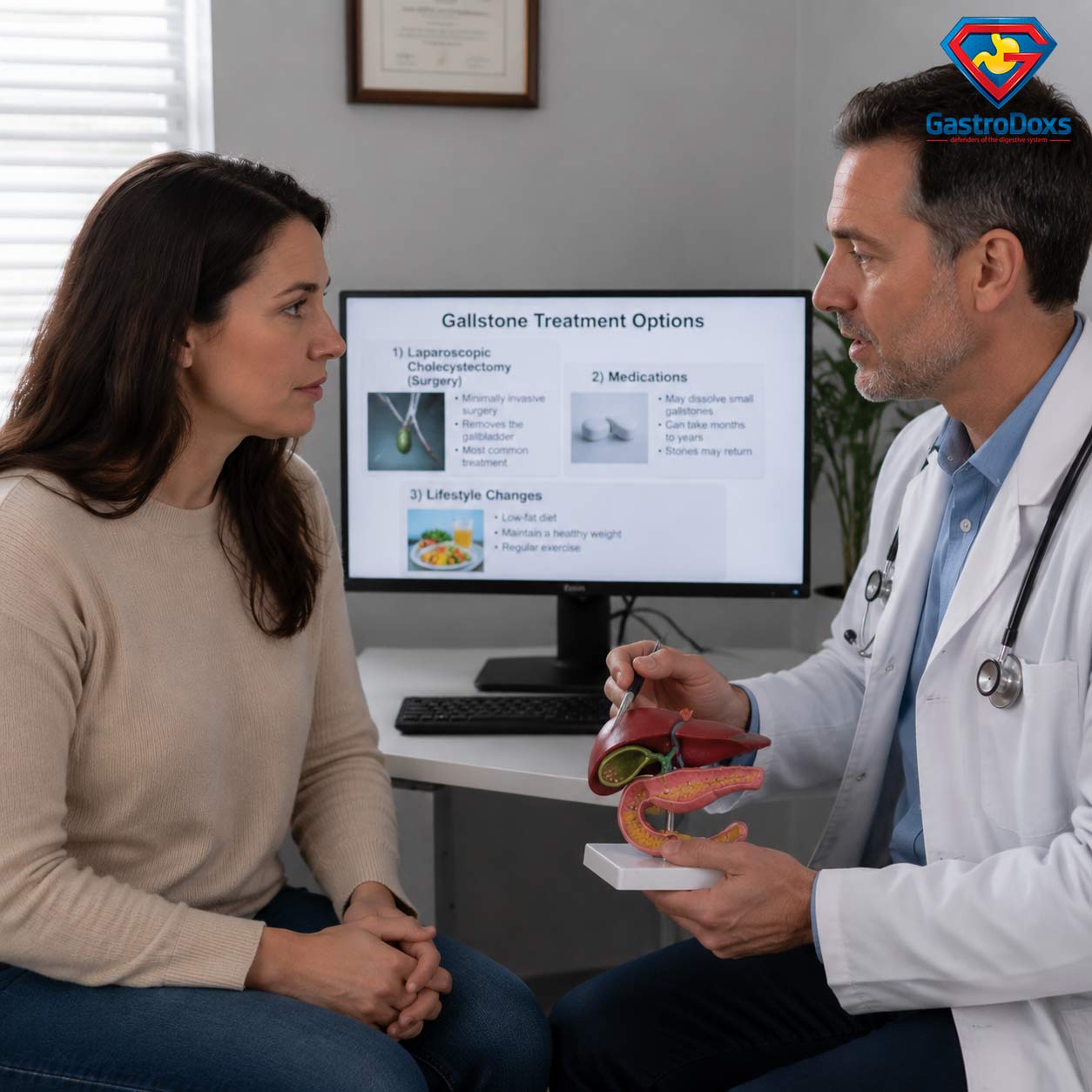
Condition-specific evaluation, evidence-based choices, clear scope, and coordinated follow-up
Gallstones found incidentally are different from stones causing repeated pain, inflammation, obstruction, or pancreatitis.
Ultrasound checks the gallbladder, while liver tests and duct imaging help identify obstruction.
ERCP can remove stones from the common bile duct but does not remove the gallbladder.
Laparoscopic cholecystectomy is the usual definitive treatment for recurring symptomatic gallstones.
A clear path from scheduling and records review to a patient-specific care plan
Share pain location, duration, meal triggers, radiation to the back or shoulder, fever, jaundice, vomiting, and prior attacks.
Bring ultrasound, CT, MRI or MRCP, liver tests, pancreatic tests, hospital notes, and medication records.
Your clinician decides whether ultrasound review, MRCP, EUS, ERCP, or urgent hospital care is appropriate.
The plan may include observation, ERCP for a duct stone, or surgical referral for recurring symptomatic gallstones.
Your guardians. GastroDoxs GutGuardians™ is our team of gastroenterologists board-certified by the American Board of Internal Medicine (ABIM) - a physician-led defense force of specialists, systems, and solution pathways working together to protect, detect, solve, and defend your digestive health through expert GI evaluation, advanced diagnostic screening, and endoscopic evaluation - commanded from your first concern to your last follow-up, and every critical stage in between.
Your rescue plan. When your diagnosis is confirmed, GastroDoxs GutRescue Mission™ deploys at full force - a gastroenterologist-led intervention plan delivering advanced colonoscopy, upper endoscopy, capsule endoscopy, and precision biologic and medication management across the full range of digestive conditions and complex GI emergencies - fighting for you with everything we have.
Book when symptoms, test results, current treatment, or the next step remains unclear
Steady right-upper or upper-middle abdominal pain after eating may reflect biliary colic.
An imaging finding alone does not always require surgery.
Jaundice, dark urine, pale stool, abnormal liver tests, or a dilated duct can indicate blockage.
Severe pain, fever, vomiting, or pancreatitis symptoms require urgent hospital evaluation.
This guidance was medically reviewed to help patients understand symptomatic gallstones, right-upper abdominal pain, ultrasound findings, bile-duct obstruction, pancreatitis risk, ERCP, and surgical coordination. Recommendations depend on the complete history, examination, test results, treatment response, and clinical urgency.






GastroDoxs provides gallstone evaluation across Houston-area locations for symptom review, ultrasound and liver-test interpretation, MRCP or EUS planning, ERCP coordination, and gallbladder-surgery referral.
Schedule a visit for recurring right-upper or upper-middle abdominal pain, nausea after meals, gallstones found on imaging with symptoms, abnormal liver tests, or uncertainty about surgery or bile-duct testing.
No. Gallstones found incidentally without symptoms often do not require treatment. The decision changes if pain, gallbladder inflammation, bile-duct obstruction, jaundice, or pancreatitis develops.
Laparoscopic gallbladder removal is the usual definitive treatment for recurring symptomatic gallstones. Pain medicine and diet changes may reduce episodes temporarily but do not remove the stones.
A gastroenterologist evaluates symptoms, liver tests, bile-duct stones, pancreatitis, and the need for MRCP, EUS, or ERCP. A surgeon removes the gallbladder when surgery is recommended.
Evaluation commonly includes abdominal ultrasound and liver tests. MRCP or endoscopic ultrasound may assess the bile duct, and ERCP is used when a duct stone needs treatment.
Yes. A migrating stone can block the common bile duct, causing jaundice, dark urine, pale stool, abnormal liver tests, infection, or pancreatitis.
MRCP and EUS are used when a common bile-duct stone is possible but not confirmed. They provide detailed duct imaging without automatically proceeding to ERCP.
ERCP is used mainly to remove a confirmed or highly suspected common bile-duct stone or relieve obstruction. It is not a routine test for gallbladder stones alone.
No. ERCP can remove stones from the bile duct and place a stent when needed, but it does not remove the gallbladder. Gallbladder surgery may still be recommended.
Surgery is commonly considered for recurring biliary pain, acute cholecystitis, gallstone pancreatitis, or complications. Symptoms, imaging, health status, and surgical risk guide the decision.
Yes. A stone can temporarily block the pancreatic and bile ducts, triggering acute pancreatitis. Severe upper-abdominal pain radiating to the back with vomiting requires emergency care.
Fever, chills, jaundice, persistent right-upper abdominal pain, confusion, or low blood pressure may signal gallbladder or bile-duct infection and requires urgent hospital evaluation.
Silent stones may be observed. Symptom medicines and diet changes do not eliminate the gallbladder source, and drug dissolution is rarely used. Recurring symptomatic stones usually lead to surgical discussion.
Bring ultrasound, CT, MRI or MRCP reports, liver and pancreatic test results, hospital records, a medication list, and details about pain timing, duration, fever, jaundice, vomiting, or pancreatitis.
Follow-up depends on whether stones are silent, surgery is planned, a duct stone was removed, or pancreatitis occurred. The plan may include surgical consultation, repeat liver tests, or post-ERCP care.
Severe or persistent pain, fever, chills, jaundice, repeated vomiting, fainting, confusion, or pancreatitis symptoms requires emergency care rather than a routine appointment.
Schedule GastroDoxs care for symptomatic gallstones, right-upper abdominal pain, ultrasound findings, bile-duct obstruction, pancreatitis risk, ERCP, and surgical coordination. Bring prior records and a medication list so your clinician can explain the safest next step. Seek emergency care for severe or persistent right-upper abdominal pain, fever, chills, jaundice, repeated vomiting, fainting, confusion, or symptoms of acute pancreatitis.



