A Duct Stone Was Seen on Imaging
MRCP, EUS, CT, or ultrasound findings can be reviewed to determine whether therapeutic ERCP is appropriate.

 Medically Reviewed by
Dr. Bharat Pothuri, MD, FACG
| Updated 07-27-2026
Common bile duct stones may require urgent drainage when infection or severe obstruction is present. GastroDoxs evaluates stable biliary records, coordinates ERCP, and plans follow-up after duct clearance.
Choledocholithiasis treatment focuses on restoring bile flow and preventing complications such as cholangitis, pancreatitis, and liver injury. GastroDoxs GutRescue Mission™ helps patients understand when ERCP is needed, what stone-removal options may be used, and how gallbladder or stent follow-up is coordinated after duct clearance.
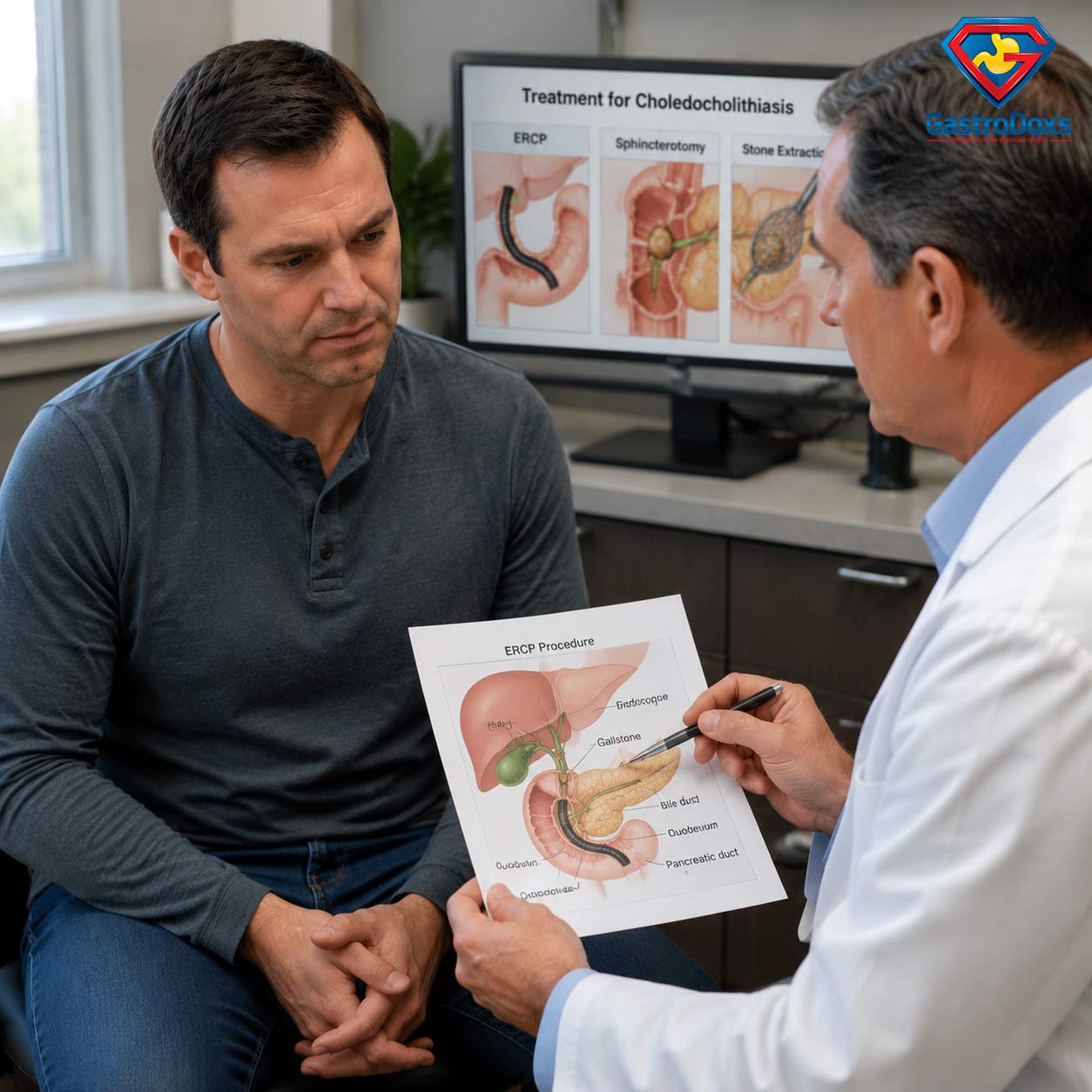
The imaging, obstruction risk, procedure need, and post-ERCP plan are addressed together.
We review the probability of a retained stone, duct dilation, bilirubin trend, pancreatic findings, and whether diagnostic imaging is complete.
Confirmed or highly likely obstructing stones can be managed with endoscopic extraction, drainage, stenting, or advanced stone techniques.
The care pathway separates stable consultation from symptoms that require antibiotics, resuscitation, urgent drainage, or inpatient treatment.
Follow-up addresses gallbladder removal, stent removal, liver-test normalization, recurrent stones, and persistent biliary symptoms.
A treatment-focused review for stable patients and post-hospital follow-up.
Upload ultrasound, CT, MRCP, EUS, ERCP, operative reports, and the images themselves when available.
Jaundice, pain, fever, itching, dark urine, pale stool, bilirubin, alkaline phosphatase, and pancreatic enzymes help define urgency.
The clinician determines whether ERCP, further imaging, stent follow-up, surgical referral, or observation fits the current evidence.
You receive next steps for gallbladder management, medicines, diet during recovery, laboratory testing, and recurrence warning signs.
Your guardians. GastroDoxs GutGuardians™ is our team of gastroenterologists board-certified by the American Board of Internal Medicine (ABIM) - a physician-led defense force of specialists, systems, and solution pathways working together to protect, detect, solve, and defend your digestive health through expert GI evaluation, advanced diagnostic screening, and endoscopic evaluation - commanded from your first concern to your last follow-up, and every critical stage in between.
Your rescue plan. When your diagnosis is confirmed, GastroDoxs GutRescue Mission™ deploys at full force - a gastroenterologist-led intervention plan delivering advanced colonoscopy, upper endoscopy, capsule endoscopy, and precision biologic and medication management across the full range of digestive conditions and complex GI emergencies - fighting for you with everything we have.
A visit is appropriate for stable patients, records review, and follow-up after urgent complications are controlled.
MRCP, EUS, CT, or ultrasound findings can be reviewed to determine whether therapeutic ERCP is appropriate.
Persistent bilirubin or alkaline phosphatase elevation after a presumed passed stone may need additional evaluation.
Temporary stents require a documented removal or exchange plan to reduce blockage and infection risk.
Patients with a gallbladder in place may need coordinated surgical planning after the common duct has been cleared.
GastroDoxs evaluates bile duct stones, coordinates EUS and ERCP, manages stent follow-up, and connects duct clearance with gallbladder and recurrence planning.






Stable biliary consultation and post-ERCP follow-up are available in Houston, Cypress, Katy, Jersey Village, and Brookshire. Emergency cholangitis or pancreatitis symptoms require hospital care first.
ERCP is the main treatment for confirmed or highly likely obstructing common bile duct stones. It may be followed by gallbladder surgery, stent removal, antibiotics for infection, and repeat laboratory testing.
ERCP is recommended when a stone is confirmed or the probability of obstruction is high and treatment is expected. Stable uncertain cases may undergo MRCP or EUS first.
Surgery is commonly recommended to remove the gallbladder after duct clearance when gallbladder stones remain and the patient is an appropriate operative candidate. Surgery is also used for selected complex biliary disease.
Yes. Most common duct stones are treated endoscopically with ERCP rather than open surgery. Gallbladder removal is a separate operation used to reduce future stone events.
During ERCP, a sphincterotomy may be performed and stones are removed with balloons or baskets. Large or difficult stones may require dilation, mechanical lithotripsy, cholangioscopy-guided lithotripsy, or staged stenting.
ERCP uses sedation or anesthesia and an endoscope passed through the mouth. Contrast and X-ray guidance identify the duct, then the clinician removes the stone or restores drainage. Observation depends on risk and findings.
It is often recommended when the gallbladder remains and contains stones because leaving it in place can lead to recurrent duct stones, pancreatitis, or cholecystitis. Timing is individualized.
The plan depends on symptoms, cholangitis or pancreatitis, bilirubin and liver tests, imaging certainty, stone size and number, anatomy, previous surgery, medical risk, and whether urgent drainage is needed.
Many patients recover from uncomplicated ERCP within a few days, but infection, pancreatitis, stent placement, advanced stone treatment, or gallbladder surgery can extend recovery.
ERCP can provide immediate drainage and stone removal. Risks include pancreatitis, bleeding, infection, perforation, sedation complications, and incomplete stone clearance. The risk-benefit balance depends on the likelihood of therapeutic benefit.
Coverage depends on the plan, network, facility, medical necessity, and authorization. Emergency treatment for cholangitis is handled through hospital benefits rather than routine office scheduling.
Yes. Stones can recur, especially when the gallbladder remains, bile flow is abnormal, or primary duct stones form. Follow-up depends on the underlying risk.
Seek immediate treatment for pain with fever or chills, jaundice, confusion, low blood pressure, severe vomiting, or pain radiating to the back.
GastroDoxs provides biliary evaluation and treatment coordination across its practice locations. Bring imaging, liver tests, ERCP reports, and surgical history.
Schedule online or call the practice for stable evaluation or follow-up. Use emergency care for fever, jaundice, confusion, severe pain, or persistent vomiting.
Get a clear plan for MRCP or EUS review, ERCP treatment, stone-removal options, stent follow-up, gallbladder referral, and recurrence prevention.



