
Food Impaction Treatment
 Medically Reviewed by
Dr. Bharat Pothuri, MD, FACG
| Updated 07-23-2026
Food stuck in the esophagus can become an emergency, especially when saliva cannot pass. Endoscopy relieves the blockage, and follow-up identifies the stricture, ring, EoE, or motility disorder behind it.
Esophageal food impaction should not be treated with forceful swallowing or home remedies when food remains stuck. GastroDoxs GutRescue Mission™ helps patients recognize complete obstruction, understand emergency endoscopic removal, and complete the follow-up needed for eosinophilic esophagitis, rings, strictures, reflux injury, tumors, or motility disorders.
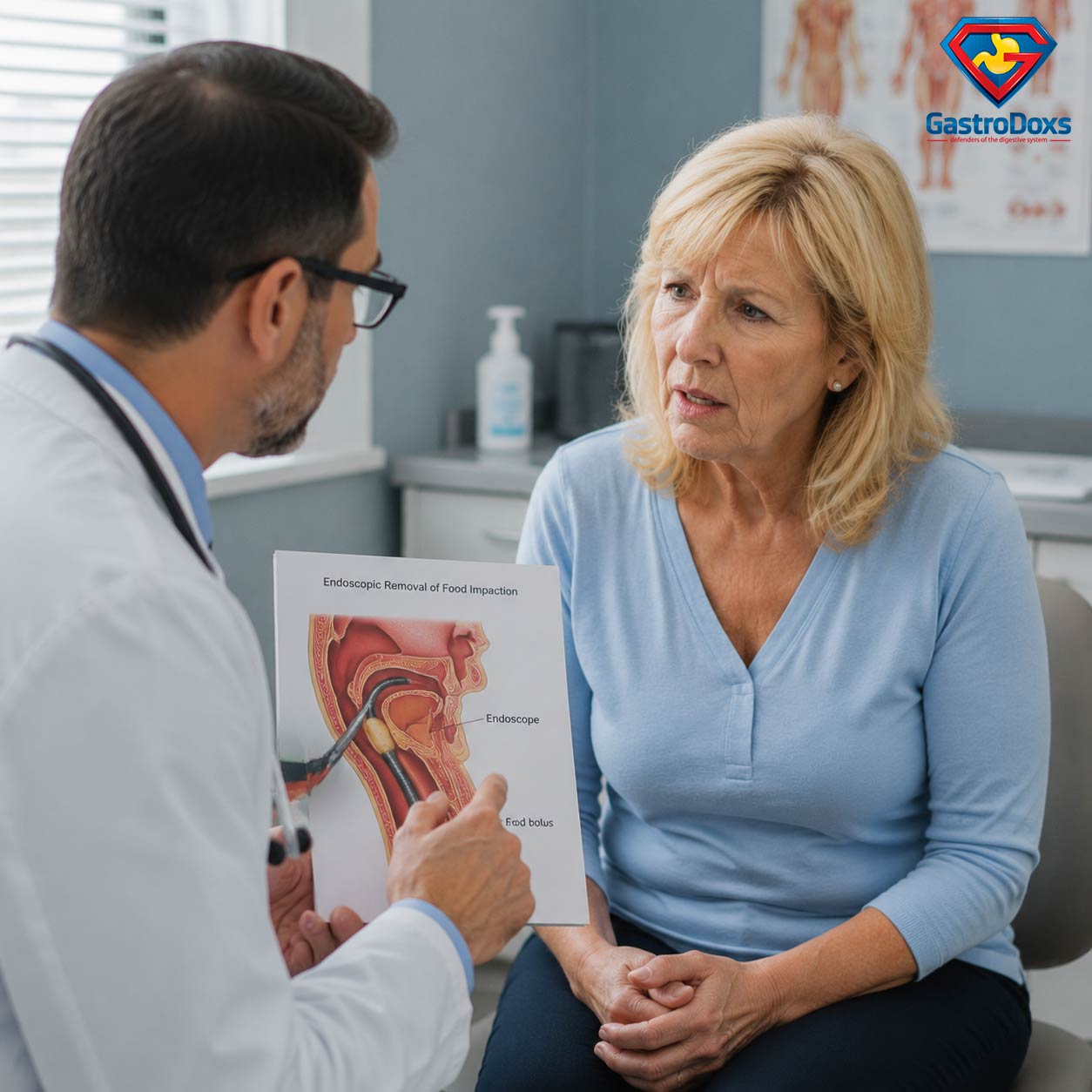
Why Choose GastroDoxs for Food Impaction Care?
Direct Emergency Triage
Patients receive clear instructions not to wait at home when saliva cannot pass or breathing is affected.
Therapeutic Endoscopy
A trained endoscopy team can remove or safely manage the food bolus while protecting the esophagus and airway.
Underlying Disease Is Investigated
EoE, Schatzki ring, peptic stricture, tumor, postsurgical narrowing, and motility disorders are considered after the acute blockage.
Recurrence Prevention
Biopsy results, dilation timing, anti-inflammatory or reflux treatment, chewing habits, food texture, and follow-up are combined into a prevention plan.
Food Impaction treatment decisions are based on urgency, the symptom pattern, medical history, prior testing, and the condition causing the problem rather than a one-size-fits-all remedy.
GastroDoxs GutGuardians™
Your guardians. GastroDoxs GutGuardians™ is our team of gastroenterologists board-certified by the American Board of Internal Medicine (ABIM) - a physician-led defense force of specialists, systems, and solution pathways working together to protect, detect, solve, and defend your digestive health through expert GI evaluation, advanced diagnostic screening, and endoscopic evaluation - commanded from your first concern to your last follow-up, and every critical stage in between.
GastroDoxs GutRescue Mission™
Your rescue plan. When your diagnosis is confirmed, GastroDoxs GutRescue Mission™ deploys at full force - a gastroenterologist-led intervention plan delivering advanced colonoscopy, upper endoscopy, capsule endoscopy, and precision biologic and medication management across the full range of digestive conditions and complex GI emergencies - fighting for you with everything we have.
What Happens Next for Food Impaction Care?
Go to the ER for a Current Blockage
If food is still stuck or saliva cannot be swallowed, do not wait for a clinic appointment or try to push it down.
Schedule Follow-Up After Removal
Book a GI visit after emergency endoscopy, even if swallowing feels normal again.
Bring the Endoscopy and Biopsy Report
Provide images, procedure notes, pathology, dilation details, prior impactions, and medicines.
Treat the Cause
The next plan may include EoE therapy, reflux medicine, scheduled dilation, manometry, nutrition guidance, or surgical referral.
Who May Benefit From a Food Impaction Appointment?
- Recent emergency food-bolus removal
- Repeated episodes of meat or bread sticking
- Food eventually passes but episodes recur
- Prior dilation with another impaction
- Atopy, asthma, eczema, or food allergy history
- Progressive swallowing difficulty or weight loss
Food Impaction Care With GastroDoxs
GastroDoxs provides post-impaction evaluation, EGD and biopsy review, EoE and reflux treatment, dilation planning, and recurrence prevention. A current complete food obstruction requires emergency endoscopy.









Food Impaction Treatment Access
After emergency removal, patients can schedule food-impaction follow-up in Cypress, Jersey Village, Katy, and Brookshire-area communities for biopsy review, EoE care, dilation planning, and recurrence prevention.
Have Questions Before Booking Food Impaction Care?
Go to an emergency department, especially if you cannot swallow saliva, are drooling, have chest pain, or have breathing difficulty. A routine office cannot safely manage a complete obstruction.
A current impaction generally requires urgent or emergency endoscopy in an appropriately equipped facility. GastroDoxs can coordinate and provide follow-up after removal.
Flexible upper endoscopy is the main treatment. The endoscopist may retrieve the food in pieces or carefully advance it when safe while assessing injury and underlying narrowing.
Do not force liquids when food is firmly stuck, especially if saliva will not pass. Home attempts can increase aspiration, vomiting, or injury and should not delay emergency care.
Complete obstruction requires emergent removal. Other persistent esophageal impactions generally require urgent endoscopy within 24 hours, with timing determined by the clinical team.
The esophagus is inspected for rings, strictures, EoE, injury, tumor, or other causes. Biopsies may be taken, and follow-up is arranged for treatment and possible dilation.
Yes. EoE is a common cause in younger and middle-aged adults. Diagnosis requires biopsies, and treatment may include medication, dietary therapy, and dilation for fixed narrowing.
Dilation may help a ring or stricture. It may be performed during or after the emergency procedure depending on inflammation, injury, anatomy, and safety.
Bring the emergency endoscopy report, images, biopsy results, dilation details, prior swallowing tests, medication list, allergy history, and a description of foods that have stuck.
Yes. Recurrence is common when the underlying ring, stricture, EoE, reflux injury, or motility disorder is untreated.
Follow the discharge diet first. Until the cause is treated, avoid dry or tough foods that repeatedly stick, take small bites, chew thoroughly, and eat slowly. Individual advice may change after evaluation.
Emergency and endoscopic coverage depends on the plan, network, deductible, facility, anesthesia, pathology, and authorization rules. Emergency care should not be delayed for cost verification.
Chronic reflux can cause a peptic stricture that narrows the esophagus. Reflux treatment and dilation may both be needed.
Yes, although benign rings, strictures, and EoE are common. Progressive dysphagia, weight loss, anemia, or older age requires prompt evaluation for a mass.
Complete the diagnostic workup, treat EoE or reflux, undergo dilation when recommended, chew thoroughly, take small bites, avoid rushed eating, and return promptly if swallowing worsens.
Follow the endoscopist's discharge plan. Timely follow-up is especially important when biopsies were taken, dilation was deferred, or the cause was not fully treated.
Take the Next Step for Food Impaction
If food impaction is active and may represent an emergency, seek urgent care first. For stable specialist evaluation, records review, treatment planning, or follow-up, book with GastroDoxs.