

★★★★★
"The GastroDoxs team carefully reviewed when food felt stuck and explained the testing and treatment options in clear, reassuring language."

 Medically Reviewed by
Dr. Bharat Pothuri, MD, FACG
| Updated 07-23-2026
Medically Reviewed by
Dr. Bharat Pothuri, MD, FACG
| Updated 07-23-2026
Difficulty swallowing can come from the mouth, throat, or esophagus. Treatment depends on whether the problem is aspiration risk, inflammation, narrowing, a motility disorder, or a food blockage.
Difficulty swallowing needs a treatment plan matched to where the swallow breaks down and why. GastroDoxs GutRescue Mission™ helps patients connect solids-versus-liquids patterns, choking or aspiration symptoms, food sticking, endoscopy and biopsy findings, swallow studies, reflux, eosinophilic esophagitis, strictures, and motility testing to the safest care path.
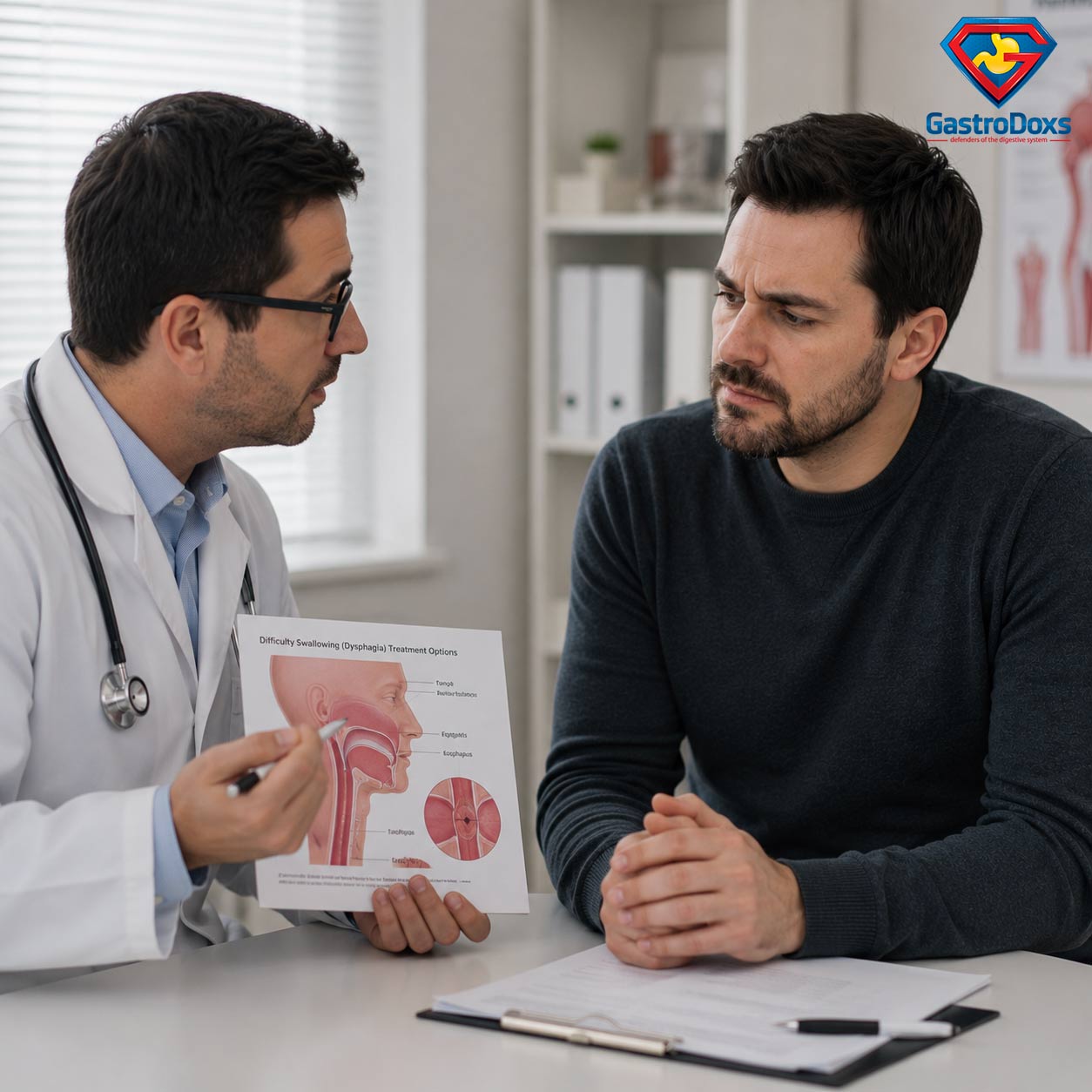
The team separates mouth-and-throat initiation problems from food sticking in the esophagus because the tests and treatments are different.
The esophagus can be examined for reflux injury, rings, strictures, eosinophilic inflammation, ulcers, infection, or tumors.
Opening a narrowing may improve swallowing, but reflux, EoE, radiation injury, surgery-related scarring, or another cause also needs management.
GI care can be coordinated with speech therapy, ENT, neurology, nutrition, radiology, or surgery when aspiration or complex disease is present.
Difficulty Swallowing treatment decisions are based on urgency, the symptom pattern, medical history, prior testing, and the condition causing the problem rather than a one-size-fits-all remedy.
Your guardians. GastroDoxs GutGuardians™ is an elite team of board-certified gastroenterologists - a physician-led defense force of specialists, systems, and solution pathways working together to protect, detect, solve, and defend your digestive health through expert GI evaluation, advanced diagnostic screening, and endoscopic evaluation - commanded from your first concern to your last follow-up, and every critical stage in between.
Your rescue plan. When your diagnosis is confirmed, GastroDoxs GutRescue Mission™ deploys at full force - a gastroenterologist-led intervention plan delivering advanced colonoscopy, upper endoscopy, capsule endoscopy, and precision biologic and medication management across the full range of digestive conditions and complex GI emergencies - fighting for you with everything we have.
Note whether solids, liquids, pills, or saliva are difficult and whether the problem starts in the throat or lower behind the breastbone.
Share coughing during meals, wet voice, repeated pneumonia, nasal regurgitation, drooling, or trouble initiating the swallow.
Provide barium studies, modified swallow tests, EGD and biopsy reports, dilation history, imaging, and medication lists.
The plan may include EGD, biopsies, dilation, reflux or EoE treatment, manometry, swallow therapy, diet texture guidance, or referral.
GastroDoxs evaluates esophageal causes of difficulty swallowing and coordinates care for throat-phase swallowing disorders. Complete obstruction, inability to swallow saliva, drooling, or breathing difficulty requires emergency care.







Difficulty-swallowing appointments are available through GastroDoxs in Cypress, Jersey Village, Katy, and Brookshire-area communities for upper endoscopy, biopsy, dilation planning, reflux or EoE care, and specialist coordination.
Yes. Stable recurring or progressive swallowing trouble can be scheduled directly. If food is completely stuck, you cannot swallow saliva, or breathing is affected, go to the emergency department.
A gastroenterologist evaluates esophageal swallowing problems. ENT and speech-language pathology often manage mouth-and-throat swallowing disorders, and neurology may be involved when a nerve or muscle condition is suspected.
It is an emergency when food is fully stuck, saliva cannot be swallowed, drooling is continuous, breathing is difficult, choking persists, or symptoms begin suddenly with stroke signs.
Treatment may include swallowing therapy, food-texture changes, reflux or EoE medicine, esophageal dilation, infection treatment, motility-directed therapy, surgery, or nutrition support depending on the cause.
Many patients with food sticking in the esophagus need EGD to inspect the lining, identify narrowing, obtain biopsies, and sometimes perform dilation. Throat-phase symptoms may require a swallow study first.
Yes, dilation can help a stricture, ring, or selected narrowing. It does not treat every cause and may need to be combined with reflux, EoE, or other disease management.
Yes. EoE commonly causes solid-food dysphagia and food impaction. Diagnosis requires esophageal biopsies, even when the lining looks nearly normal.
Yes. Reflux may cause inflammation or a peptic stricture. New or progressive dysphagia should not be treated as simple reflux without evaluation.
Bring a symptom timeline, list of foods or liquids that cause trouble, medication list, prior EGD and biopsy reports, swallow studies, dilation records, imaging, and information about weight loss or pneumonia.
Coverage varies by plan and may depend on referrals, authorization, and the tests performed. Contact the insurer and GastroDoxs scheduling team for plan-specific details.
Cost depends on insurance, facility, anesthesia, biopsy or pathology, and whether dilation is performed. A specific estimate requires procedure and benefit details.
Choose textures you can swallow safely, take small bites, chew thoroughly, eat slowly, and avoid foods that repeatedly stick. Do not force food through, and seek urgent care if swallowing suddenly worsens.
Yes, but many noncancerous conditions are more common. Progressive symptoms, weight loss, anemia, pain, or older age increase the need for prompt endoscopy.
Progressive dysphagia should be assessed promptly, especially with weight loss, anemia, vomiting, pain, or food impaction. Do not wait for complete obstruction.
Temporary symptoms may resolve, but recurrent or progressive difficulty often persists until the underlying inflammation, narrowing, motility problem, or neurologic issue is treated.
Yes. Speech-language pathologists can teach positioning, exercises, pacing, and texture strategies for oropharyngeal dysphagia and aspiration risk. Therapy is selected after a swallowing assessment.
If difficulty swallowing is persistent, recurring, progressive, or affecting eating, breathing, sleep, or daily life, book a focused GI evaluation and get a clearer treatment plan.