
Biliary Colic After Fatty Meals Treatment
 Medically Reviewed by
Dr. Bharat Pothuri, MD, FACG
| Updated July 29, 2026
Get a definitive plan for repeated fatty-meal pain, gallstones, ultrasound findings, laparoscopic cholecystectomy, bile-duct stone risk, and complication prevention.
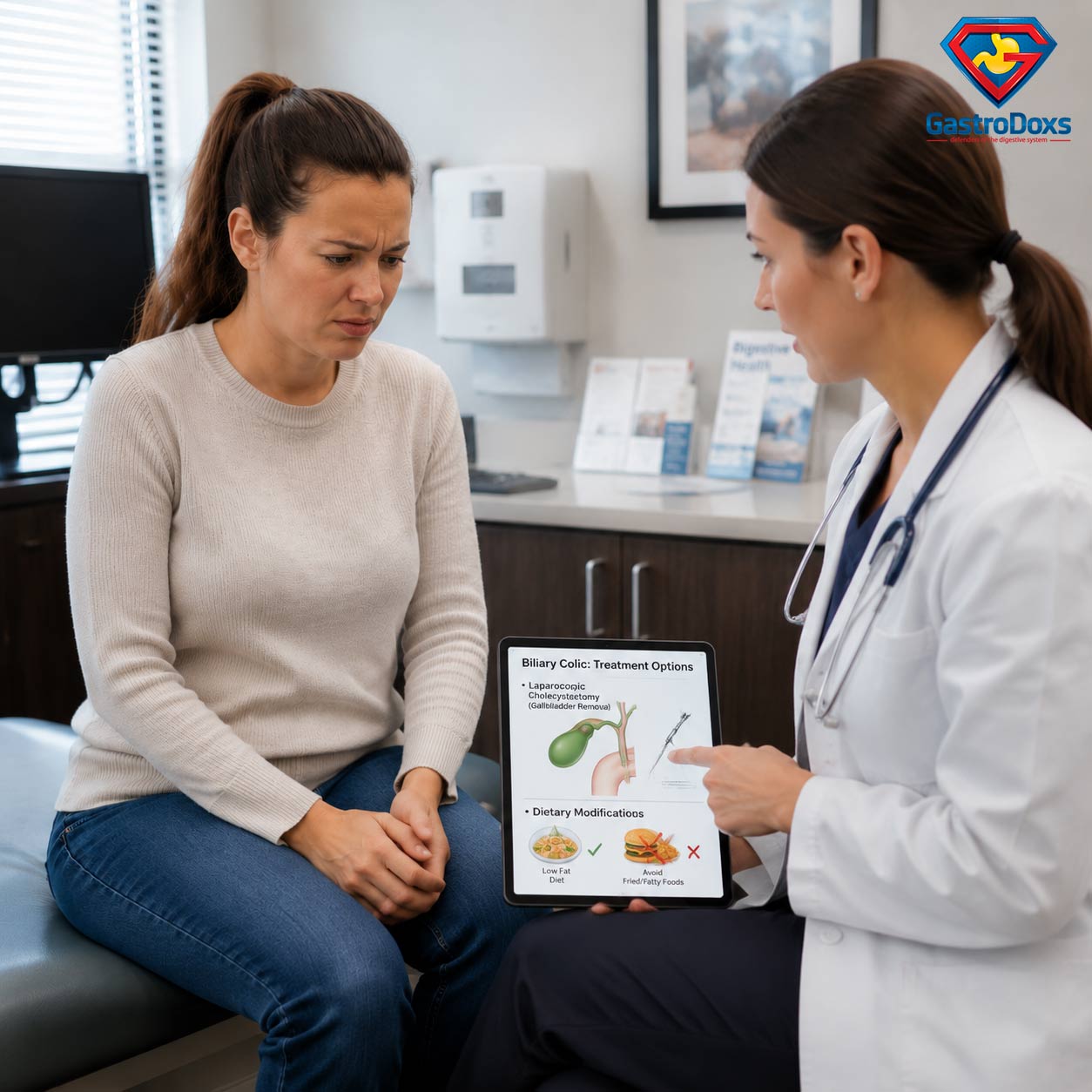
Biliary colic treatment focuses on confirming symptomatic gallstones, controlling attacks, and preventing progression to cholecystitis, bile-duct obstruction, cholangitis, or pancreatitis. GastroDoxs GutRescue Mission™ connects meal-related pain, ultrasound and laboratory findings, surgical referral, ERCP questions, diet guidance, and emergency thresholds.
Why Choose GastroDoxs for Biliary Colic After Fatty Meals Care?
Gallstone Pattern and Ultrasound Review
The team connects meal-triggered steady pain with ultrasound findings, liver tests, bilirubin, lipase, and prior emergency records.
Surgical Referral With Clear Indication
Recurrent symptomatic gallstones are coordinated with a surgeon for laparoscopic cholecystectomy planning.
Bile-Duct Stone Risk Assessment
Jaundice, abnormal bilirubin, dilated ducts, pancreatitis, or cholangitis features guide MRCP, endoscopic ultrasound, ERCP, or hospital care.
Attack and Complication Guidance
Patients receive lower-fat meal guidance, pain and nausea planning, and explicit signs that should bypass routine scheduling.
The goal is to distinguish uncomplicated biliary colic from complications that need urgent antibiotics, drainage, ERCP, or surgery.
GastroDoxs GutGuardians™
Your guardians. GastroDoxs GutGuardians™ is our team of gastroenterologists board-certified by the American Board of Internal Medicine (ABIM) - a physician-led defense force of specialists, systems, and solution pathways working together to protect, detect, solve, and defend your digestive health through expert GI evaluation, advanced diagnostic screening, and endoscopic evaluation - commanded from your first concern to your last follow-up, and every critical stage in between.
GastroDoxs GutRescue Mission™
Your rescue plan. When your diagnosis is confirmed, GastroDoxs GutRescue Mission™ deploys at full force - a gastroenterologist-led intervention plan delivering advanced colonoscopy, upper endoscopy, capsule endoscopy, and precision biologic and medication management across the full range of digestive conditions and complex GI emergencies - fighting for you with everything we have.
What Happens After You Book?
Bring the Attack Timeline
Record the meal, start and stop time, pain location, shoulder or back radiation, nausea, vomiting, fever, jaundice, and urine or stool changes.
Send Ultrasound and Laboratory Results
Provide gallstone imaging, gallbladder findings, liver tests, bilirubin, lipase, CT, HIDA, MRCP, and emergency records.
Confirm Uncomplicated vs Complicated Disease
The clinician checks for cholecystitis, common bile-duct stones, cholangitis, and pancreatitis before outpatient treatment.
Plan Surgery or Bile-Duct Treatment
The next step may include laparoscopic cholecystectomy, MRCP, endoscopic ultrasound, ERCP, or urgent hospital care.
Who May Benefit From a Biliary Colic After Fatty Meals Appointment?
- Repeated RUQ Pain After Fatty Meals
- Gallstones Found on Ultrasound
- Pain Returns After Emergency Treatment
- Abnormal Liver Tests or Dilated Bile Duct
- Prior Gallstone Pancreatitis
- Diet Restrictions Are Affecting Daily Life
Medical Review and Specialist Coordination
GastroDoxs evaluates recurrent biliary colic, reviews gallstone and bile-duct testing, coordinates laparoscopic cholecystectomy referral, and arranges MRCP, endoscopic ultrasound, ERCP, or urgent care when indicated.









Biliary Colic Treatment and Gallstone Surgery Guidance
Stable recurring biliary colic can be reviewed in a scheduled GI setting. Persistent severe pain, fever, jaundice, confusion, repeated vomiting, or severe back-radiating pain requires urgent evaluation.
Have Questions Before Booking Biliary Colic After Fatty Meals Care?
Biliary colic is temporary upper abdominal pain caused by increased pressure behind a partial or brief obstruction in the gallbladder or bile ducts. Gallstones are the most common cause.
Fat signals the gallbladder to contract. If a stone blocks the outlet, pressure rises and produces steady pain under the right ribs or in the upper middle abdomen. The episode ends when the obstruction releases or contraction stops.
Typical symptoms include sudden, intense, steady right upper or upper middle abdominal pain with nausea, vomiting, sweating, or radiation to the right shoulder blade or back. Fever and jaundice suggest a complication.
An episode commonly lasts at least 20 to 30 minutes and may continue for several hours before fading. Pain that remains severe beyond several hours, especially with fever or tenderness, raises concern for cholecystitis.
Gallstones or sludge can temporarily obstruct the cystic duct when the gallbladder contracts. Less common causes include gallbladder dysmotility, bile-duct stones, strictures, or sphincter disorders.
Yes. A stone may shift and release the blockage, so attacks can stop and later return. Recurrent symptoms indicate that the underlying gallstone or gallbladder problem remains.
Diagnosis uses the characteristic pain pattern, examination, blood tests, and right upper abdominal ultrasound. The clinician also checks for cholecystitis, cholangitis, bile-duct stones, pancreatitis, ulcer disease, and cardiac mimics.
Ultrasound is the usual first test. CBC, liver tests, bilirubin, and lipase check for complications. HIDA scan, MRCP, endoscopic ultrasound, CT, or ERCP may be used for selected questions.
The pain may stop when a stone moves, but the stone usually remains and attacks may recur. Definitive treatment for symptomatic gallstones is commonly laparoscopic gallbladder removal.
Until evaluation, smaller lower-fat meals may reduce gallbladder contractions and attacks. Avoid personal triggers, very large fried meals, and crash dieting. Diet does not dissolve most gallstones.
Go to the emergency department for severe pain that does not improve, fever, chills, jaundice, confusion, fainting, repeated vomiting, dark urine with pale stool, black or bloody stool, chest symptoms, or a rigid abdomen.
Pain and nausea are treated first. Symptomatic gallstones are commonly managed with laparoscopic cholecystectomy. Bile-duct stones may require ERCP, and infection requires urgent antibiotics and source control.
No. Gallstones found incidentally without symptoms often do not require surgery. Recurrent biliary colic, complications, or certain high-risk findings may make cholecystectomy appropriate.
Yes. A stone can remain blocked and cause acute cholecystitis, enter the common bile duct and cause jaundice or cholangitis, or obstruct the pancreatic duct and cause pancreatitis.
Regular meals, gradual weight loss when needed, physical activity, and avoiding rapid weight cycling may reduce gallstone risk. Once symptomatic stones exist, lifestyle measures may reduce triggers but do not reliably prevent recurrence.
Laparoscopic cholecystectomy is the standard surgical treatment for most people with symptomatic gallstones who can safely undergo anesthesia. Risks and expected benefit are reviewed with the surgeon before treatment.
Book a Biliary Colic Treatment Evaluation
Get a clear plan for gallstone attacks, cholecystectomy, bile-duct testing, and complication prevention. Seek urgent care for persistent pain, fever, jaundice, confusion, repeated vomiting, or pancreatitis symptoms.