Solid Food Repeatedly Sticks
Schedule when meat, bread, pills, or other solids pause behind the breastbone or require regurgitation.

 Medically Reviewed by
Dr. Bharat Pothuri, MD, FACG
| Updated 07-29-2026
Get treatment for intermittent solid-food dysphagia and food impaction with upper endoscopy, esophageal dilation, reflux care, and recurrence planning.
Schatzki's ring treatment usually uses upper endoscopy with balloon or bougie dilation when the narrowing causes solid-food dysphagia or food impaction. GastroDoxs GutRescue Mission™ helps connect ring severity, reflux, hiatal hernia, eosinophilic esophagitis biopsies, procedural risks, recovery instructions, and recurrence planning.
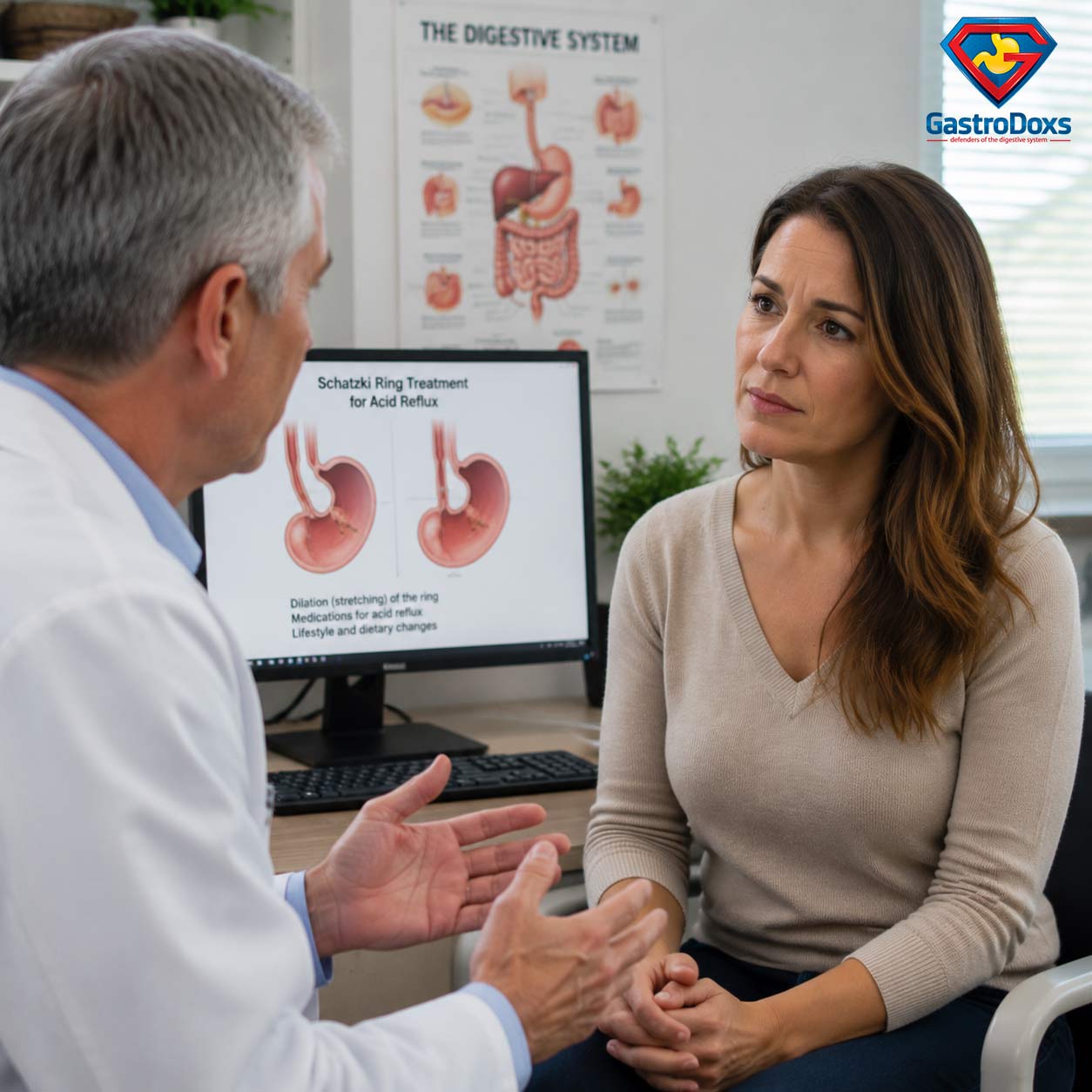
Treatment is matched to the diagnosis, symptom burden, prior care, risks, and the least invasive option likely to help —a distinction used in the solid-food dysphagia and dilation pathway.
The team distinguishes intermittent solid-food sticking from progressive narrowing and motility disorders that also affect liquids.
Balloon or wire-guided bougie dilation is selected according to ring diameter, anatomy, inflammation, anticoagulants, and prior treatment.
PPI treatment and esophageal biopsies are considered because reflux and eosinophilic esophagitis can influence recurrence.
The plan includes chewing, bite size, food texture, emergency instructions, and follow-up if dysphagia returns.
A structured path from records and symptoms to treatment, monitoring, or referral.
Record whether meat, bread, pills, or other solids cause symptoms and whether liquids pass normally.
Share prior endoscopy, dilation, barium esophagram, pathology, food-impaction treatment, reflux therapy, and allergy history.
The clinician reviews fasting, sedation, anticoagulants, biopsy needs, dilation method, and perforation risk.
The plan covers diet advancement, reflux therapy, warning signs, follow-up, and when repeat dilation may be needed.
Your guardians. GastroDoxs GutGuardians™ is our team of gastroenterologists board-certified by the American Board of Internal Medicine (ABIM) - a physician-led defense force of specialists, systems, and solution pathways working together to protect, detect, solve, and defend your digestive health through expert GI evaluation, advanced diagnostic screening, and endoscopic evaluation - commanded from your first concern to your last follow-up, and every critical stage in between.
Your rescue plan. When your diagnosis is confirmed, GastroDoxs GutRescue Mission™ deploys at full force - a gastroenterologist-led intervention plan delivering advanced colonoscopy, upper endoscopy, capsule endoscopy, and precision biologic and medication management across the full range of digestive conditions and complex GI emergencies - fighting for you with everything we have.
Schedule when symptoms are recurring, affecting daily life, or remain unresolved after initial care.
Schedule when meat, bread, pills, or other solids pause behind the breastbone or require regurgitation.
Prior emergency removal increases the need to identify and treat the ring and evaluate eosinophilic esophagitis.
Reduced intake, prolonged chewing, avoidance of restaurants, or weight loss suggests that dysphagia is affecting nutrition and quality of life.
Repeat evaluation can determine whether the ring recurred, reflux is uncontrolled, or another inflammatory or motility disorder is present.
GastroDoxs evaluates solid-food dysphagia, performs upper endoscopy and selected esophageal dilation, obtains biopsies when eosinophilic esophagitis is possible, and plans reflux treatment and recurrence follow-up.






GastroDoxs provides evaluation and treatment for intermittent solid-food dysphagia, recurrent food sticking, prior impaction, reflux-related narrowing, and symptoms returning after esophageal dilation.
The standard treatment for a symptomatic Schatzki ring is endoscopic esophageal dilation. Balloon or wire-guided bougie dilation can widen the ring. Reflux treatment and esophageal biopsies for eosinophilic esophagitis may be included because they can affect recurrence and long-term management.
Dilation is recommended when the ring causes intermittent solid-food dysphagia, repeated food sticking, reduced intake, or food impaction. An incidental ring without symptoms usually does not need treatment.
Yes. Treatment is usually nonsurgical and performed during upper endoscopy. Surgery is rarely needed. Selected recurrent rings may be treated with endoscopic incision or another advanced endoscopic technique.
Expect fasting, sedation or anesthesia review, upper endoscopy, inspection of the ring, and possible esophageal biopsies. A balloon or bougie gently widens the narrowing. Mild sore throat or chest discomfort may occur, and severe pain, fever, breathing difficulty, or vomiting blood needs urgent care.
The clinician reviews whether symptoms affect solids, liquids, or both; prior food impaction; ring diameter; reflux; hiatal hernia; eosinophilic esophagitis risk; anticoagulants; and prior dilation response. Progressive dysphagia or weight loss requires exclusion of cancer or another stricture.
Proton pump inhibitor therapy is commonly recommended after dilation when reflux is present and may reduce relapse of Schatzki's ring. The dose and duration depend on reflux symptoms, esophagitis, hiatal hernia, medication risks, and recurrence history.
Many people resume liquids soon after sedation recovery and advance food according to discharge instructions. Mild throat or chest soreness may last a short time. The endoscopy team gives specific guidance based on dilation size, biopsies, and any procedural findings.
Yes. Dysphagia can recur months or years after successful dilation, and repeat endoscopy or dilation may be needed. Reflux control and evaluation for eosinophilic esophagitis may reduce avoidable recurrence.
The main benefit is improved passage of solid food and lower food-impaction risk. Risks include bleeding, pain, aspiration, sedation complications, and rare esophageal perforation. The risk is influenced by ring tightness, inflammation, prior surgery, and dilation technique.
Some people improve after one dilation, while others need repeat treatment because the ring narrows again or another condition contributes to dysphagia. Follow-up is based on symptoms rather than a fixed schedule.
After dilation, follow the endoscopy team's staged diet instructions. Long term, take small bites, chew thoroughly, eat slowly, add moisture to dry foods, and stop eating if food begins to stick. Diet changes reduce impaction risk but do not remove a recurrent ring.
Coverage varies for the consultation, upper endoscopy, dilation, anesthesia, pathology, biopsies, and reflux medicines. Confirm network status, referral rules, authorization, facility benefits, and expected patient responsibility before the procedure.
A gastroenterologist who performs upper endoscopy and esophageal dilation treats Schatzki rings. GastroDoxs can review dysphagia history, prior food impactions, barium studies, endoscopy reports, and biopsy results and plan the appropriate procedure.
Schedule care for recurring solid-food dysphagia, painful swallowing, regurgitation, or weight loss. Seek emergency care if food is completely stuck, saliva cannot be swallowed, breathing is difficult, or severe chest pain develops.
Use the online appointment link or call GastroDoxs. Bring prior endoscopy, dilation, barium-esophagram, pathology, allergy, reflux, and food-impaction records and a list of foods that repeatedly stick.
Get a plan for solid-food dysphagia, endoscopy, esophageal dilation, reflux treatment, biopsies, and recurrence. Seek emergency care when food is completely stuck or saliva cannot be swallowed.



