Dysphagia With Confirmed Hypercontractility
Swallowing difficulty plus a compatible manometry pattern may respond to motility-directed treatment.

 Medically Reviewed by
Dr. Bharat Pothuri, MD, FACG
| Updated 07-28-2026
Treatment is reserved for clinically relevant hypercontractile swallowing symptoms after structural disease, reflux, and cardiac causes are addressed.
Jackhammer esophagus treatment should be based on both high-resolution manometry and compatible symptoms such as dysphagia or noncardiac chest pain. GastroDoxs GutRescue Mission™ connects manometry tracings, endoscopy, reflux testing, swallowing patterns, medication risks, and cardiac evaluation to a stepwise plan that avoids unnecessary invasive treatment.
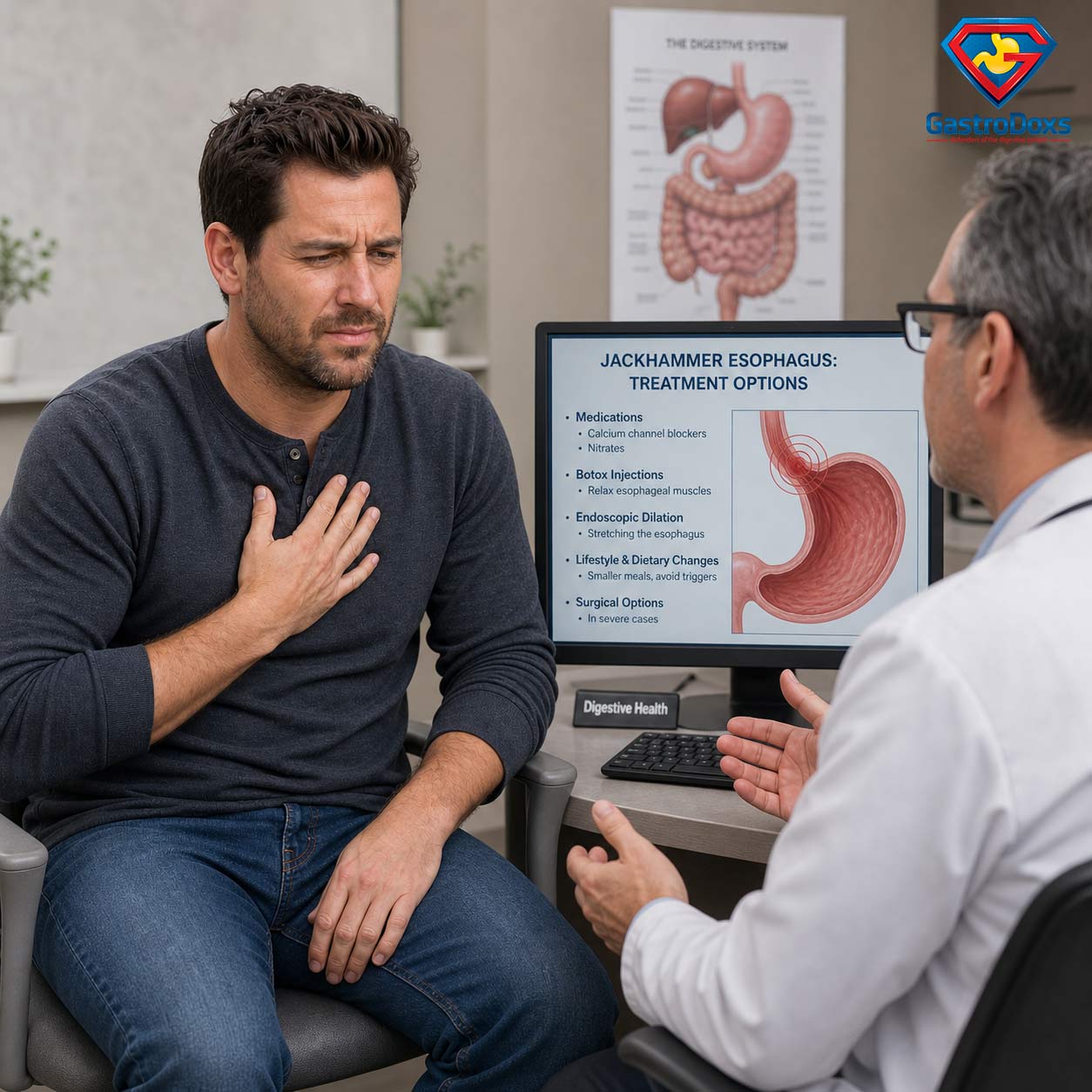
The plan links the manometry finding to real symptoms before escalating care.
We confirm whether hypercontractile swallows meet current criteria and whether symptoms occurred with the abnormal contractions.
Endoscopy, barium imaging, and reflux testing may be used to exclude blockage, eosinophilic disease, ulcer, or acid-driven symptoms.
Options may include swallowing changes, reflux care, smooth-muscle relaxants, neuromodulators, or selected endoscopic therapy.
Patients considered for POEM receive discussion of symptom likelihood, reflux risk, procedure alternatives, and the need for expert follow-up.
The visit confirms the diagnosis and matches treatment intensity to symptom burden.
Bring the complete report and, when available, the actual pressure topography rather than only the summary diagnosis.
Describe solids versus liquids, food sticking, meal triggers, regurgitation, weight loss, and any cardiac evaluation.
Endoscopy, biopsy, barium study, and reflux testing may be reviewed or planned before invasive motility treatment.
The plan may begin with conservative measures or medication and progress to Botox, dilation, or POEM only when justified.
Your guardians. GastroDoxs GutGuardians™ is our team of gastroenterologists board-certified by the American Board of Internal Medicine (ABIM) - a physician-led defense force of specialists, systems, and solution pathways working together to protect, detect, solve, and defend your digestive health through expert GI evaluation, advanced diagnostic screening, and endoscopic evaluation - commanded from your first concern to your last follow-up, and every critical stage in between.
Your rescue plan. When your diagnosis is confirmed, GastroDoxs GutRescue Mission™ deploys at full force - a gastroenterologist-led intervention plan delivering advanced colonoscopy, upper endoscopy, capsule endoscopy, and precision biologic and medication management across the full range of digestive conditions and complex GI emergencies - fighting for you with everything we have.
An abnormal manometry test matters most when it explains the patient’s symptoms.
Swallowing difficulty plus a compatible manometry pattern may respond to motility-directed treatment.
After urgent cardiac causes are excluded, esophageal spasm and pain sensitivity can be evaluated.
Ongoing dysphagia or chest pain may require confirmation that reflux is not the only driver.
A second review can confirm diagnosis, symptom correlation, segment length, and whether less invasive options were adequate.
GastroDoxs evaluates jackhammer esophagus through manometry review, upper endoscopy, biopsy, reflux assessment, and stepwise treatment. Options may include diet and swallowing changes, medication, botulinum toxin, dilation, or referral for POEM in selected refractory cases.






GastroDoxs provides manometry and endoscopy review, reflux evaluation, medication planning, and coordination for advanced motility procedures. New severe chest pain must be evaluated urgently for a heart cause.
Treatment may include swallowing and dietary adjustments, treatment of proven reflux, smooth-muscle relaxants, pain-modulating medicines, botulinum toxin, dilation, or POEM for selected severe refractory cases. The manometry finding must fit the symptoms.
Options may include calcium-channel blockers, nitrates, phosphodiesterase inhibitors, or low-dose neuromodulators in selected patients. Benefits are variable, and low blood pressure, headache, dizziness, and interactions must be considered.
Yes. Many patients begin with conservative measures and medication. Surgery is rarely used; POEM is an endoscopic myotomy rather than traditional surgery and is reserved for selected cases.
POEM may be considered when severe dysphagia or chest pain persists, manometry confirms clinically relevant hypercontractility, structural disease is excluded, and less invasive treatment has not provided acceptable relief.
Doctors review symptom severity, manometry pattern, endoscopy and biopsy, barium imaging, reflux evidence, cardiac evaluation, weight loss, food impaction, prior treatment response, and patient preference.
High-resolution manometry is central. Upper endoscopy with biopsy helps rule out narrowing, ulcer, cancer, and eosinophilic esophagitis. A barium study and reflux monitoring may be added based on symptoms.
Expect a stepwise plan and discussion of how success will be measured. Medication may require dose adjustment, while procedures need preparation, anesthesia, diet progression, and reflux follow-up.
Medication response may be noticed within days to weeks. Behavioral and meal changes can help sooner. Recovery after Botox, dilation, or POEM varies, and full symptom assessment may take weeks.
POEM can reduce severe spastic contractions and improve swallowing in selected patients. Risks include bleeding, perforation, infection, anesthesia complications, post-procedure reflux, and incomplete or recurrent symptoms.
Yes. Symptoms can recur after medication, Botox, or a procedure, and some patients develop a different motility pattern over time. Follow-up is based on symptoms and objective testing when needed.
Smaller bites, slow eating, thorough chewing, warm liquids, and avoiding extreme food temperatures or personal triggers may help. These changes do not replace evaluation for obstruction or another disease.
Coverage varies for manometry, endoscopy, reflux monitoring, medication, Botox, dilation, and POEM. GastroDoxs can help verify benefits and authorization requirements.
A gastroenterologist with esophageal motility expertise is appropriate. GastroDoxs can review testing, plan initial treatment, and coordinate an advanced endoscopist when POEM is considered.
Seek prompt care for progressive swallowing difficulty, weight loss, repeated food sticking, or persistent chest pain. New severe chest pain, shortness of breath, sweating, or fainting requires emergency evaluation for a heart cause.
Use online scheduling or call GastroDoxs. Bring manometry, endoscopy and biopsy, barium study, reflux testing, cardiology records, and a list of treatments already tried.
Get a stepwise plan based on manometry, swallowing symptoms, reflux evidence, and prior treatment. Call emergency services for new severe chest pain, fainting, shortness of breath, or symptoms suggesting a heart problem.



