Ongoing Bloody Diarrhea or Urgency
Persistent symptoms may require infection testing, activity measurement, and treatment escalation.

 Medically Reviewed by
Dr. Bharat Pothuri, MD, FACG
| Updated 07-28-2026
Treatment controls inflammation while the care team continues to evaluate whether the disease behaves more like ulcerative colitis or Crohn disease.
Indeterminate colitis treatment is based on disease location, severity, complications, prior response, and whether the pattern is closer to ulcerative colitis or Crohn disease. GastroDoxs GutRescue Mission™ connects symptoms, colonoscopy, pathology, stool markers, imaging, medication history, nutrition, and patient goals to a treat-to-target plan without waiting for every label to become perfect.
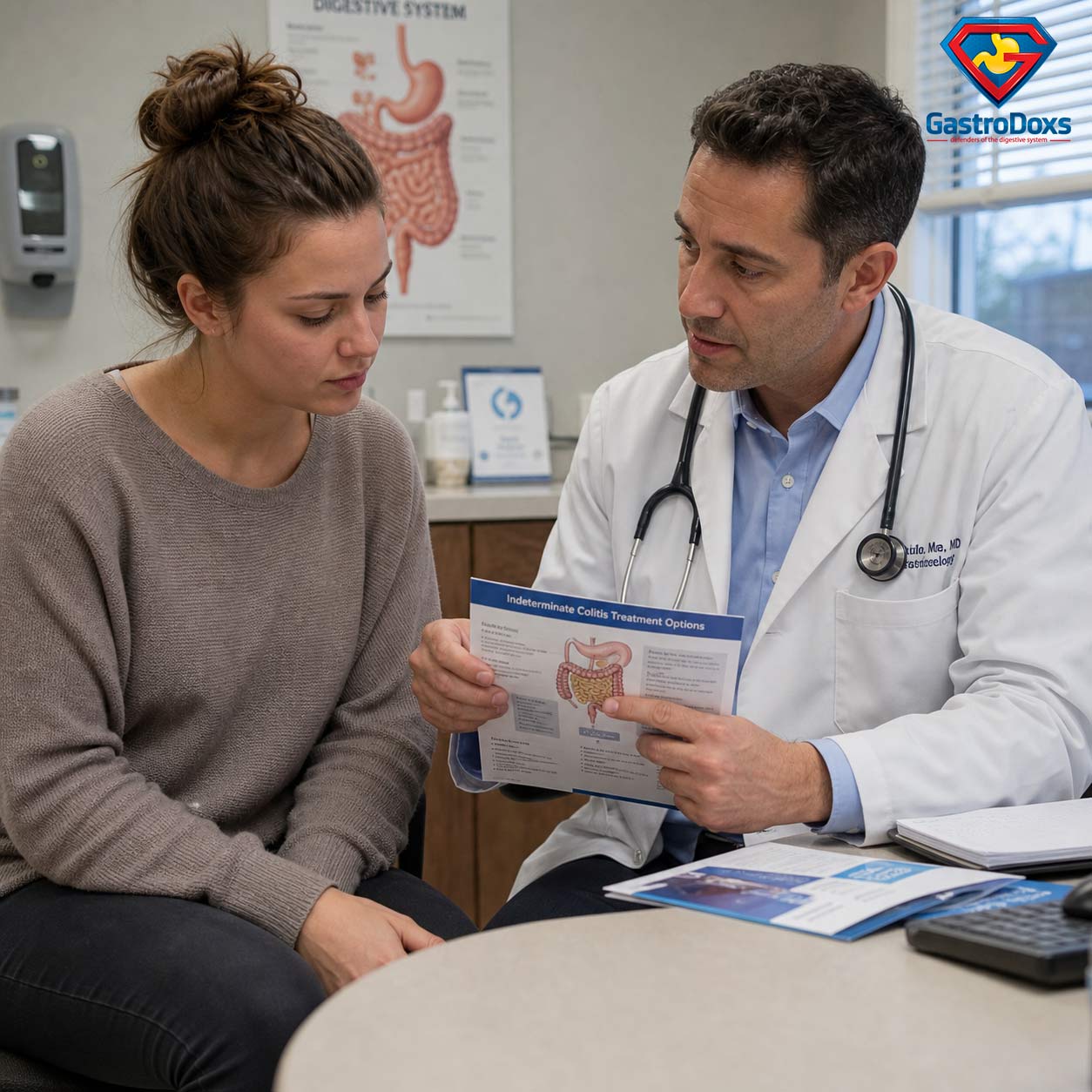
The plan treats the inflammation while preserving flexibility as the diagnosis evolves.
We compare colonoscopy, biopsy, small-bowel imaging, infection testing, and treatment history for clues toward ulcerative colitis or Crohn disease.
Treatment is chosen to control symptoms, normalize inflammatory markers, reduce steroid exposure, and support mucosal healing.
We assess weight loss, iron deficiency, vitamin status, hydration, and food tolerance during flares and remission.
Early colorectal-surgery discussion is appropriate when disease is severe, refractory, dysplastic, or complicated, especially when pouch suitability is uncertain.
The visit turns uncertain labeling into a measurable treatment plan.
Bring prior colonoscopy, pathology, imaging, stool tests, hospital records, and every treatment tried.
Symptoms are paired with blood counts, inflammatory markers, stool calprotectin, infection testing, and endoscopy when needed.
The plan separates short-term flare control from long-term steroid-sparing remission therapy.
Follow-up defines what improvement means and when labs, stool testing, imaging, or colonoscopy will be repeated.
Your guardians. GastroDoxs GutGuardians™ is our team of gastroenterologists board-certified by the American Board of Internal Medicine (ABIM) - a physician-led defense force of specialists, systems, and solution pathways working together to protect, detect, solve, and defend your digestive health through expert GI evaluation, advanced diagnostic screening, and endoscopic evaluation - commanded from your first concern to your last follow-up, and every critical stage in between.
Your rescue plan. When your diagnosis is confirmed, GastroDoxs GutRescue Mission™ deploys at full force - a gastroenterologist-led intervention plan delivering advanced colonoscopy, upper endoscopy, capsule endoscopy, and precision biologic and medication management across the full range of digestive conditions and complex GI emergencies - fighting for you with everything we have.
Specialist care helps when symptoms persist or the diagnosis affects treatment choices.
Persistent symptoms may require infection testing, activity measurement, and treatment escalation.
Frequent steroid courses suggest the need for a safer maintenance strategy.
A coordinated re-review can clarify disease extent and prevent treatment based on one isolated report.
The possibility of Crohn disease affects procedure selection, pouch counseling, and long-term expectations.
GastroDoxs treats indeterminate colitis with objective disease monitoring, 5-ASA when appropriate, short-term corticosteroids for selected flares, steroid-sparing advanced therapy, nutrition support, colonoscopic surveillance, and colorectal-surgery coordination.






GastroDoxs provides IBD medication management, lab and stool-marker monitoring, colonoscopy and pathology review, nutrition support, surveillance, and colorectal-surgery coordination for indeterminate colitis.
Treatment is individualized using disease severity and phenotype. Options include 5-ASA therapy, corticosteroids for short-term induction, immunomodulators, biologics, small-molecule therapies, nutrition support, and surgery for refractory disease or complications.
Common treatments may include mesalamine for mild colonic disease, corticosteroids for short-term flare control, and steroid-sparing agents such as biologics, immunomodulators, or oral small molecules for moderate to severe disease.
Yes. Many patients are managed medically. Surgery is reserved for severe medication-refractory disease, uncontrolled bleeding, toxic megacolon, perforation, dysplasia or cancer, or other major complications.
Biologic therapy may be recommended for moderate to severe disease, steroid dependence, high-risk features, failure of conventional therapy, fistulizing behavior, or the need for a steroid-sparing maintenance plan.
Doctors consider symptoms, colonoscopy and biopsy, small-bowel imaging, stool infection tests, inflammatory markers, disease extent, complications, prior response, medication safety, and whether the pattern resembles ulcerative colitis or Crohn disease.
Expect baseline infection screening and labs, education about the medication, a monitoring schedule, and defined treatment targets. Some therapies work within weeks, while full response and mucosal healing can take longer.
Symptom improvement may begin within days to weeks depending on the treatment, but objective healing can take months. Lack of improvement should prompt reassessment for infection, inadequate dosing, complications, or a different diagnosis.
Diet cannot cure IBD, but adequate protein, calories, hydration, iron, and vitamin replacement are important. During flares, a temporary lower-residue plan may improve tolerance; long-term restriction should be guided by a clinician or dietitian.
Surgery is considered for uncontrolled severe colitis, perforation, toxic megacolon, major bleeding, dysplasia or cancer, or failure of appropriate medical therapy. Diagnostic uncertainty should be discussed before pouch surgery.
Biologics can induce and maintain remission and reduce steroid exposure. Risks vary by drug and may include infection, infusion or injection reactions, liver or blood abnormalities, and rare serious events, so screening and monitoring are required.
Yes. Long-term clinical and endoscopic remission is possible, although treatment usually continues to maintain control and the diagnosis may become more specific over time.
Coverage varies for consultation, colonoscopy, lab and stool testing, infusion services, and advanced medication. GastroDoxs can help with benefits review and prior authorization.
A gastroenterologist with inflammatory bowel disease experience is appropriate. GastroDoxs can review complex records, manage treatment, and coordinate colorectal surgery when needed.
Seek specialist care for ongoing bleeding, frequent diarrhea, weight loss, anemia, steroid dependence, nighttime symptoms, or unclear prior treatment. Emergency care is needed for severe bleeding, dehydration, fever, marked abdominal swelling, or fainting.
Use online scheduling or call GastroDoxs. Bring colonoscopy and pathology reports, imaging, medication history, recent labs, and a list of current symptoms and stool frequency.
Get a treat-to-target plan for bleeding, diarrhea, steroid dependence, biologic selection, nutrition, monitoring, and surgery decisions. Severe bleeding, dehydration, fever, marked swelling, or fainting needs urgent care.



