Varices Found Without Active Bleeding
A specialist review can define the varix type, bleeding risk, portal anatomy, and whether preventive treatment is appropriate.

 Medically Reviewed by
Dr. Bharat Pothuri, MD, FACG
| Updated 07-28-2026
Gastric varices can cause life-threatening bleeding and require coordinated endoscopy, liver care, imaging, and hospital-based treatment.
Gastric varices treatment depends on whether bleeding is active, the varix type, the anatomy of portal blood flow, liver function, and available endoscopic and interventional expertise. GastroDoxs GutRescue Mission™ connects bleeding history, endoscopy, cross-sectional imaging, portal-hypertension cause, liver status, and hospital coordination to the safest next step.
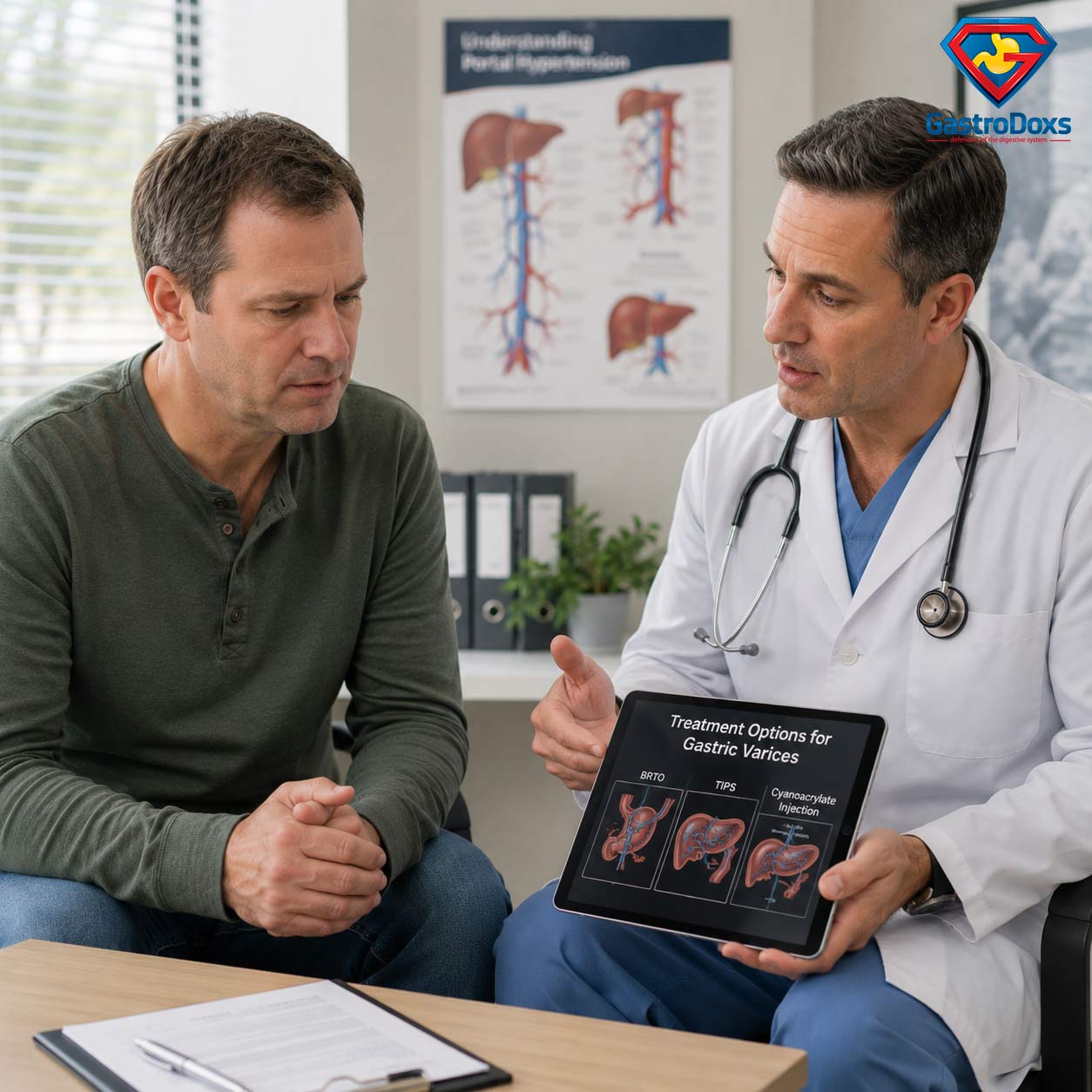
Safe care requires the right setting and coordination across specialties.
We clearly direct active bleeding to emergency care and use clinic visits for post-hospital review, prevention, and liver-disease management.
The varix type, location, bleeding signs, portal-vein anatomy, and shunts help determine which therapy is feasible.
Treatment includes evaluation of cirrhosis, portal vein thrombosis, and other causes that drive variceal formation.
Advanced treatment may involve hepatology, interventional radiology, advanced endoscopy, transplant services, and surgery.
Non-emergency visits focus on preventing another bleed and treating the cause.
Bring endoscopy reports, transfusion details, imaging, discharge notes, and procedure records from the bleeding episode.
We review liver tests, blood counts, clotting, kidney function, encephalopathy history, ascites, and portal-vein anatomy.
The team determines whether repeat endoscopy, EUS therapy, TIPS, RTO, medication, or another specialist is needed.
You receive guidance on warning signs, medication adherence, laboratory monitoring, liver care, and planned procedures.
Your guardians. GastroDoxs GutGuardians™ is our team of gastroenterologists board-certified by the American Board of Internal Medicine (ABIM) - a physician-led defense force of specialists, systems, and solution pathways working together to protect, detect, solve, and defend your digestive health through expert GI evaluation, advanced diagnostic screening, and endoscopic evaluation - commanded from your first concern to your last follow-up, and every critical stage in between.
Your rescue plan. When your diagnosis is confirmed, GastroDoxs GutRescue Mission™ deploys at full force - a gastroenterologist-led intervention plan delivering advanced colonoscopy, upper endoscopy, capsule endoscopy, and precision biologic and medication management across the full range of digestive conditions and complex GI emergencies - fighting for you with everything we have.
Clinic care is for stable patients after emergency bleeding has been controlled or for planned prevention.
A specialist review can define the varix type, bleeding risk, portal anatomy, and whether preventive treatment is appropriate.
Post-discharge care helps prevent recurrence and ensures the underlying liver or portal condition is addressed.
Repeated bleeding may require review for TIPS, RTO, EUS-guided therapy, or another advanced option.
Ongoing liver and portal-hypertension management is essential even after the varix itself is treated.
GastroDoxs provides stable-patient follow-up, endoscopic assessment, liver and portal-hypertension evaluation, and coordination of advanced therapy for gastric varices. Active bleeding is a medical emergency and must be treated in a hospital.






GastroDoxs provides scheduled follow-up after bleeding control, portal-hypertension evaluation, endoscopy review, and coordination with hepatology and interventional teams. Active bleeding requires emergency services immediately.
Treatment may include urgent resuscitation and medicines, endoscopic cyanoacrylate injection where available, EUS-guided coil and glue therapy, TIPS, or retrograde transvenous obliteration. The choice depends on active bleeding, varix type, portal anatomy, liver function, and expertise.
Immediate treatment is required for vomiting blood, black tarry stools, fainting, confusion, rapid heartbeat, low blood pressure, or severe weakness. Do not wait for a clinic appointment.
Yes. Many treatments are endoscopic or radiologic rather than surgical. Surgery is uncommon and usually considered when less invasive options are unsuitable or have failed.
Endoscopic options can include tissue-adhesive injection and EUS-guided coil with glue therapy. Standard banding is used for some gastroesophageal varices but is not the preferred approach for all fundal gastric varices.
Doctors consider the varix classification, active bleeding, endoscopy, CT or MRI anatomy, gastrorenal shunts, portal vein patency, liver function, encephalopathy, ascites, and prior therapy.
Hospital medicines may include vasoactive therapy and antibiotics in patients with cirrhosis during acute bleeding. Nonselective beta blockers may be used in selected prevention plans, but medication alone is not sufficient for every gastric varix pattern.
During endoscopic treatment, sedation or anesthesia is used and the varix is treated through a scope. Hospital observation, repeat blood counts, and additional imaging or radiology treatment may be needed.
TIPS may be recommended when bleeding cannot be controlled, recurs, or when portal decompression is needed and the patient is an appropriate candidate. Risks such as encephalopathy and liver failure are considered.
Recovery depends on whether treatment was endoscopic, TIPS, RTO, or another intervention and on the severity of bleeding and liver disease. Hospital stays and follow-up vary widely.
Treatment can prevent fatal rebleeding, but risks include bleeding, embolization, ulceration, infection, encephalopathy, liver decompensation, procedure complications, and recurrence. The risk profile differs by procedure.
Yes. Varices can recur or new varices can form because portal hypertension continues. Ongoing endoscopic, imaging, and liver follow-up is essential.
Coverage varies for hospitalization, endoscopy, anesthesia, interventional radiology, imaging, and liver care. In an emergency, treatment should not be delayed for benefit verification.
A gastroenterologist or hepatologist experienced in portal hypertension should coordinate care with advanced endoscopy and interventional radiology. GastroDoxs can provide stable follow-up and specialty coordination.
Follow-up may include endoscopy, imaging, blood counts, liver and kidney tests, medication review, encephalopathy and ascites monitoring, and treatment of the underlying liver or portal-vein condition.
Use online scheduling or call GastroDoxs for stable follow-up and records review. Active bleeding requires emergency services or immediate emergency-department care instead.
Schedule stable-patient follow-up for endoscopy review, portal-hypertension care, and prevention planning. Call emergency services now for vomiting blood, black stools, fainting, confusion, or severe weakness.



