Burning or Gnawing Upper Abdominal Pain
Pain between meals, early-morning discomfort, or pain that temporarily improves with food may fit a duodenal ulcer pattern.

 Medically Reviewed by
Dr. Bharat Pothuri, MD, FACG
| Updated July 17, 2026
Medically Reviewed by
Dr. Bharat Pothuri, MD, FACG
| Updated July 17, 2026
Duodenal ulcers can cause burning upper abdominal pain, nausea, bloating, nighttime discomfort, black stool, or bleeding concerns. GastroDoxs helps patients move from symptom guessing to focused ulcer evaluation, H. pylori review, medication planning, and next-step treatment guidance.
Duodenal ulcers form in the first part of the small intestine and often need a clear care plan, not repeated antacid guessing. GastroDoxs GutRescue Mission™ supports patients who are ready for ulcer testing, H. pylori treatment review, NSAID risk discussion, endoscopy planning, bleeding-warning review, and follow-up care to help the ulcer heal safely.
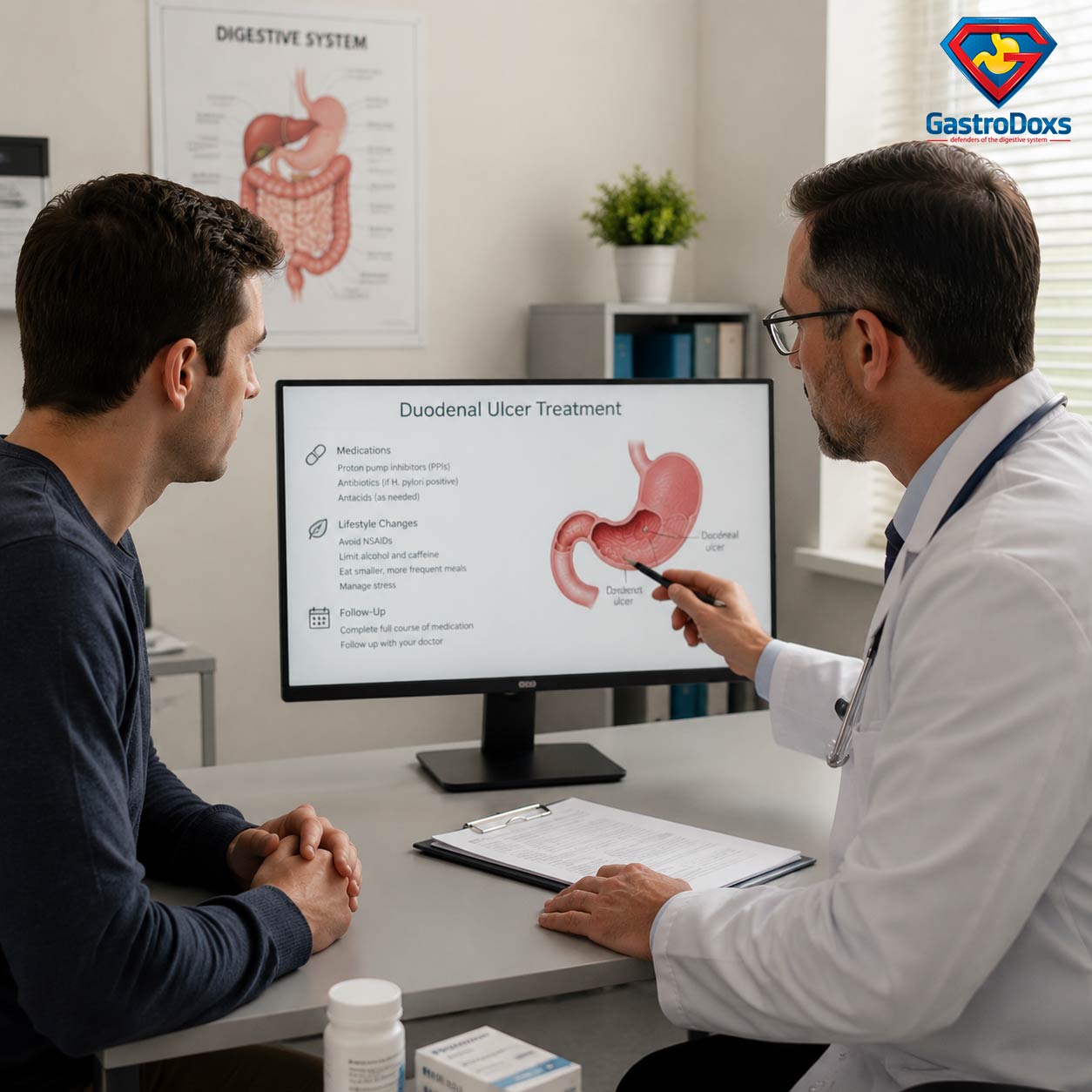
A digestive-specialist visit helps connect symptoms, records, test results, risk factors, and care coordination into a clearer plan.
Your visit connects pain timing, nighttime symptoms, food response, nausea, black stool, anemia concerns, NSAID use, and prior treatment attempts into a clearer ulcer care pathway.
GastroDoxs can review whether breath, stool, blood, or biopsy-based H. pylori testing is appropriate and whether acid suppression, antibiotics, or NSAID alternatives should be discussed.
When symptoms are persistent, severe, recurrent, or linked with bleeding signs, upper endoscopy may be recommended to inspect the esophagus, stomach, and duodenum directly.
Bleeding, perforation, obstruction, vomiting blood, black stool, dizziness, or sudden severe pain may need urgent care instead of routine scheduling.
A simple visit path for treatment planning and next-step clarity.
Book online or call for an appointment focused on suspected or previously diagnosed duodenal ulcer symptoms.
Share NSAID use, aspirin use, blood thinners, acid reducers, antibiotics, supplements, and any prior ulcer treatment.
Your provider may review H. pylori testing, blood work, stool testing, prior imaging, or upper endoscopy depending on symptoms and risk.
Your plan may include acid suppression, H. pylori eradication, medication changes, dietary trigger review, repeat testing, or urgent referral when complications are possible.
Your guardians. GastroDoxs GutGuardians™ is an elite team of board-certified gastroenterologists - a physician-led defense force of specialists, systems, and solution pathways working together to protect, detect, solve, and defend your digestive health through expert GI evaluation, advanced diagnostic screening, and endoscopic evaluation - commanded from your first concern to your last follow-up, and every critical stage in between.
Your rescue plan. When your diagnosis is confirmed, GastroDoxs GutRescue Mission™ deploys at full force - a gastroenterologist-led intervention plan delivering advanced colonoscopy, upper endoscopy, capsule endoscopy, and precision biologic and medication management across the full range of digestive conditions and complex GI emergencies - fighting for you with everything we have.
Schedule GI care when symptoms, test results, or prior records need clearer next-step review.
Pain between meals, early-morning discomfort, or pain that temporarily improves with food may fit a duodenal ulcer pattern.
Testing and treatment review can help when H. pylori is suspected or was found on prior breath, stool, blood, or biopsy testing.
Long-term ibuprofen, naproxen, aspirin, or blood thinner use can raise ulcer and bleeding risk and should be reviewed carefully.
These signs can suggest ulcer bleeding and may need urgent evaluation, blood work, endoscopy, or hospital-based care.
If ulcer symptoms return after medication, GastroDoxs can review adherence, H. pylori eradication, repeat testing, and next-step endoscopy.
GastroDoxs supports duodenal ulcer care with symptom review, H. pylori testing guidance, medication-risk review, endoscopy planning, and follow-up for healing, recurrence, or complications.







Patients with suspected duodenal ulcer symptoms can use GastroDoxs for non-emergency GI evaluation, records review, endoscopy discussion, and treatment planning. Severe bleeding, fainting, or sudden severe pain should be handled urgently.
You can schedule a GastroDoxs GI evaluation for suspected or diagnosed duodenal ulcer symptoms. The visit reviews pain pattern, H. pylori risk, NSAID use, prior treatment, and whether endoscopy or urgent care is needed.
Fast healing depends on the cause. Treatment often includes a proton pump inhibitor, H. pylori antibiotics when infection is present, avoiding NSAIDs when appropriate, and close follow-up for bleeding or complication signs.
A gastroenterologist is the right specialist for ongoing duodenal ulcer symptoms, endoscopy planning, H. pylori testing, and medication review. Severe bleeding or sudden severe pain should go to emergency care first.
Yes. Vomiting blood, black tarry stool, fainting, severe weakness, sudden sharp abdominal pain, or signs of perforation can require emergency evaluation and hospital-based treatment.
Bleeding ulcer symptoms should be handled through an emergency department because urgent labs, blood support, IV medicine, endoscopy, radiology, or surgery may be needed depending on severity.
Upper endoscopy is often used when symptoms are persistent, complicated, recurrent, or concerning. It allows direct viewing of the duodenum and can include biopsy or H. pylori testing.
Common options include proton pump inhibitors, H2 blockers, protective medicines, and H. pylori antibiotics when needed. The best choice depends on cause, bleeding risk, medication history, and test results.
Yes. Ulcers can recur if H. pylori is not fully eradicated, NSAIDs continue, smoking continues, acid suppression is stopped too early, or another risk factor remains untreated.
A perforated ulcer is a medical emergency. It can leak digestive contents into the abdomen and cause severe infection, sudden pain, rigid abdomen, shock, and need for urgent surgery.
Surgery is uncommon but may be needed for perforation, uncontrolled bleeding, obstruction, or ulcers that do not respond to medical and endoscopic treatment.
When H. pylori is the cause, successful eradication plus acid suppression can allow healing and reduce recurrence risk. Follow-up testing may be needed to confirm the infection is gone.
Warning signs include black stool, vomiting blood, severe weakness, dizziness, sudden severe pain, persistent vomiting, unexplained weight loss, anemia, or pain that spreads to the back.
Yes. Severe, sudden, worsening, or spreading pain, especially with vomiting blood, black stool, fainting, fever, or rigid abdomen, should be evaluated urgently.
A strong plan includes finding the cause, confirming H. pylori status, adjusting ulcer-risk medicines, completing treatment, confirming healing when needed, and preventing recurrence.
Diet can reduce irritation for some people, but it does not replace medical treatment. Avoid personal triggers, alcohol, smoking, and NSAIDs unless your clinician advises otherwise.
A diagnosed ulcer should be treated promptly. Urgency is higher when pain is severe, bleeding is suspected, anemia is present, vomiting occurs, or symptoms are worsening despite medication.
If burning upper abdominal pain, nausea, black stool concern, H. pylori history, NSAID use, or recurring ulcer symptoms are disrupting your life, schedule a focused GI evaluation with GastroDoxs.