Bright red or dark red rectal bleeding with known diverticula
Heavy rectal bleeding, clots, dizziness, fainting, weakness, chest symptoms, or ongoing bleeding can be serious and should be handled through urgent or emergency care.

 Medically Reviewed by
Dr. Bharat Pothuri, MD, FACG
| Updated July 17, 2026
Medically Reviewed by
Dr. Bharat Pothuri, MD, FACG
| Updated July 17, 2026
Diverticular bleeding can cause sudden bright red or dark red blood from the rectum and may become serious. GastroDoxs GutRescue Mission™ helps patients understand urgent warning signs, hospital records, colonoscopy follow-up, and recurrence planning.
Diverticular bleeding occurs when a blood vessel connected to a colon pouch breaks open. GastroDoxs GutRescue Mission™ helps patients understand when rectal bleeding needs emergency care, when colonoscopy or imaging may be needed, how medications can affect bleeding risk, and how follow-up is planned after a bleeding episode.
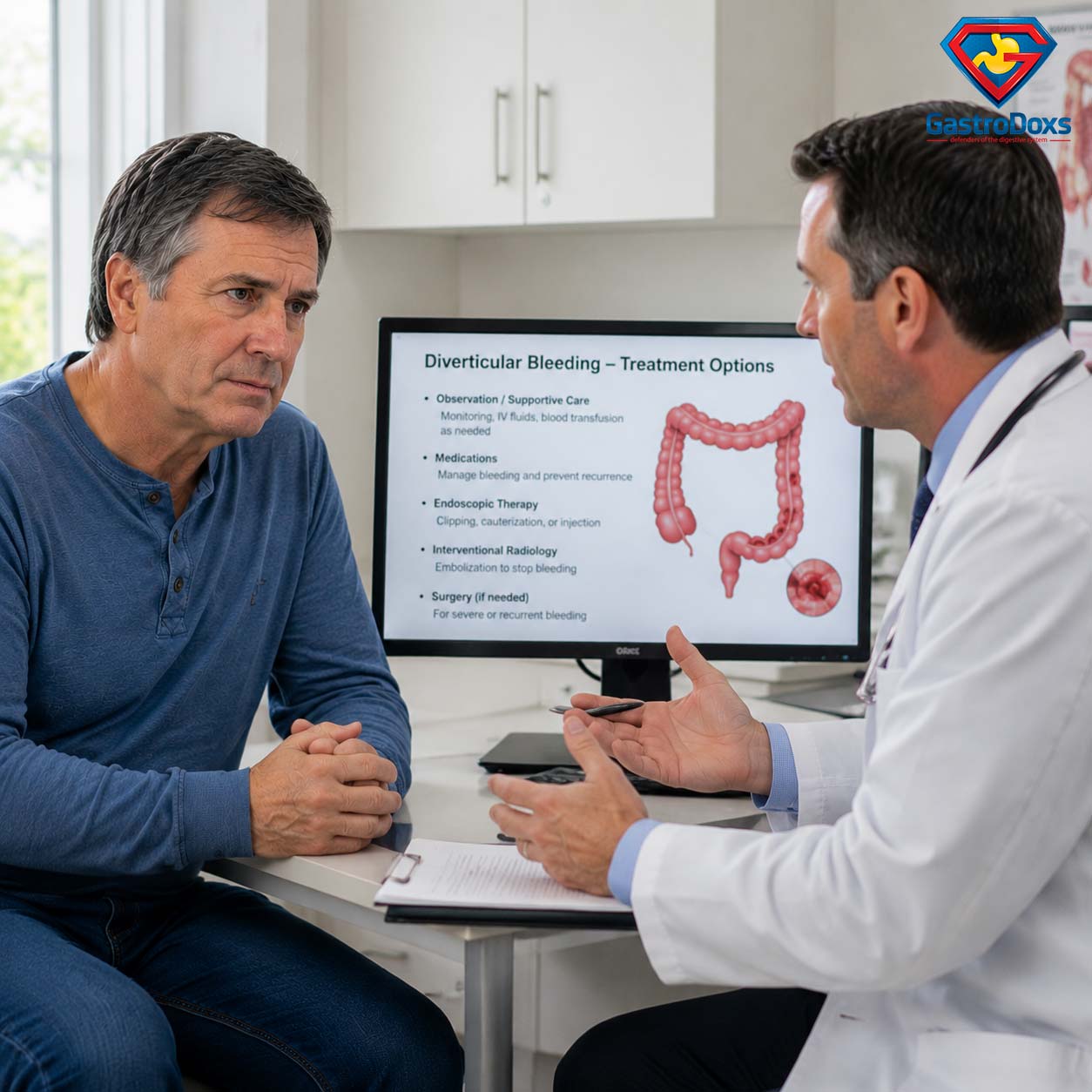
Digestive-focused decision support, records review, testing guidance, and clear next-step planning.
GastroDoxs reviews bleeding pattern, anemia, medication risks, prior colonoscopy, CT angiography, hospital records, and recurrence risk.
Colonoscopy may help identify the bleeding source, rule out other causes, and plan follow-up after stabilization.
Aspirin, blood thinners, NSAIDs, and supplements may affect bleeding risk and should be reviewed with the right clinician.
Patients who were treated urgently often need clear instructions about anemia, recurrence, diet, medications, and when to return.
A simple visit path for treatment-stage decision making.
Heavy bleeding, clots, dizziness, fainting, weakness, or ongoing bleeding should be evaluated urgently or in an emergency setting.
Share colonoscopy, CT angiography, bleeding scan, transfusion, discharge, medication, and anemia records.
Your provider reviews whether bleeding was likely diverticular and whether other causes need to be ruled out.
The plan may include colonoscopy timing, anemia monitoring, medication review, and instructions for recurrent bleeding.
Your guardians. GastroDoxs GutGuardians™ is an elite team of board-certified gastroenterologists - a physician-led defense force of specialists, systems, and solution pathways working together to protect, detect, solve, and defend your digestive health through expert GI evaluation, advanced diagnostic screening, and endoscopic evaluation - commanded from your first concern to your last follow-up, and every critical stage in between.
Your rescue plan. When your diagnosis is confirmed, GastroDoxs GutRescue Mission™ deploys at full force - a gastroenterologist-led intervention plan delivering advanced colonoscopy, upper endoscopy, capsule endoscopy, and precision biologic and medication management across the full range of digestive conditions and complex GI emergencies - fighting for you with everything we have.
Schedule a GI-focused visit when symptoms, reports, or prior findings need clearer next steps.
Heavy rectal bleeding, clots, dizziness, fainting, weakness, chest symptoms, or ongoing bleeding can be serious and should be handled through urgent or emergency care.
Severe diverticular bleeding should be evaluated in an emergency setting. GastroDoxs can help with GI follow-up after stabilization and records review.
Diverticular Bleeding treatment depends on symptoms, test results, risk factors, and prior records. GastroDoxs can help review digestive findings, explain next steps, and coordinate care when needed.
Diverticular bleeding can recur. Follow-up may include medication review, anemia monitoring, colonoscopy planning, and a clear emergency action plan.
Tests may include blood counts, colonoscopy, CT angiography, tagged red blood cell scan, and other imaging to identify the bleeding source.
Diverticular Bleeding treatment depends on symptoms, test results, risk factors, and prior records. GastroDoxs can help review digestive findings, explain next steps, and coordinate care when needed.
GastroDoxs supports diverticular bleeding follow-up with colonoscopy planning, hospital-record review, medication risk review, anemia monitoring, and recurrence-prevention guidance.







Diverticular bleeding should be triaged by severity first, then followed with careful GI evaluation once the patient is stable.
Heavy rectal bleeding, clots, dizziness, fainting, weakness, chest symptoms, or ongoing bleeding can be serious and should be handled through urgent or emergency care.
Severe diverticular bleeding should be evaluated in an emergency setting. GastroDoxs can help with GI follow-up after stabilization and records review.
Heavy rectal bleeding, clots, dizziness, fainting, weakness, chest symptoms, or ongoing bleeding can be serious and should be handled through urgent or emergency care.
Heavy rectal bleeding, clots, dizziness, fainting, weakness, chest symptoms, or ongoing bleeding can be serious and should be handled through urgent or emergency care.
Heavy rectal bleeding, clots, dizziness, fainting, weakness, chest symptoms, or ongoing bleeding can be serious and should be handled through urgent or emergency care.
Heavy rectal bleeding, clots, dizziness, fainting, weakness, chest symptoms, or ongoing bleeding can be serious and should be handled through urgent or emergency care.
Heavy rectal bleeding, clots, dizziness, fainting, weakness, chest symptoms, or ongoing bleeding can be serious and should be handled through urgent or emergency care.
Heavy rectal bleeding, clots, dizziness, fainting, weakness, chest symptoms, or ongoing bleeding can be serious and should be handled through urgent or emergency care.
Heavy rectal bleeding, clots, dizziness, fainting, weakness, chest symptoms, or ongoing bleeding can be serious and should be handled through urgent or emergency care.
Heavy rectal bleeding, clots, dizziness, fainting, weakness, chest symptoms, or ongoing bleeding can be serious and should be handled through urgent or emergency care.
Heavy rectal bleeding, clots, dizziness, fainting, weakness, chest symptoms, or ongoing bleeding can be serious and should be handled through urgent or emergency care.
Heavy rectal bleeding, clots, dizziness, fainting, weakness, chest symptoms, or ongoing bleeding can be serious and should be handled through urgent or emergency care.
Heavy rectal bleeding, clots, dizziness, fainting, weakness, chest symptoms, or ongoing bleeding can be serious and should be handled through urgent or emergency care.
Heavy rectal bleeding, clots, dizziness, fainting, weakness, chest symptoms, or ongoing bleeding can be serious and should be handled through urgent or emergency care.
Heavy rectal bleeding, clots, dizziness, fainting, weakness, chest symptoms, or ongoing bleeding can be serious and should be handled through urgent or emergency care.
Heavy rectal bleeding, clots, dizziness, fainting, weakness, chest symptoms, or ongoing bleeding can be serious and should be handled through urgent or emergency care.
Active heavy bleeding, clots, dizziness, fainting, or weakness should be handled urgently. After stabilization, GastroDoxs can help with GI follow-up, colonoscopy planning, records review, and recurrence guidance.