Steroids Keep Being Repeated
Frequent prednisone or budesonide use suggests the maintenance plan is not achieving durable steroid-free control.

 Medically Reviewed by
Dr. Bharat Pothuri, MD, FACG
| Updated 07-27-2026
Crohn's colitis treatment is selected according to disease severity, complications, prior therapy, colon involvement, and objective inflammation. GastroDoxs builds a treat-to-target plan for symptom control and durable remission.
Crohn's colitis treatment should control symptoms and heal inflammation rather than rely on repeated short steroid courses. GastroDoxs GutRescue Mission™ helps patients compare advanced therapies, nutrition needs, monitoring, complication risk, and the steps required to reach and maintain steroid-free remission.
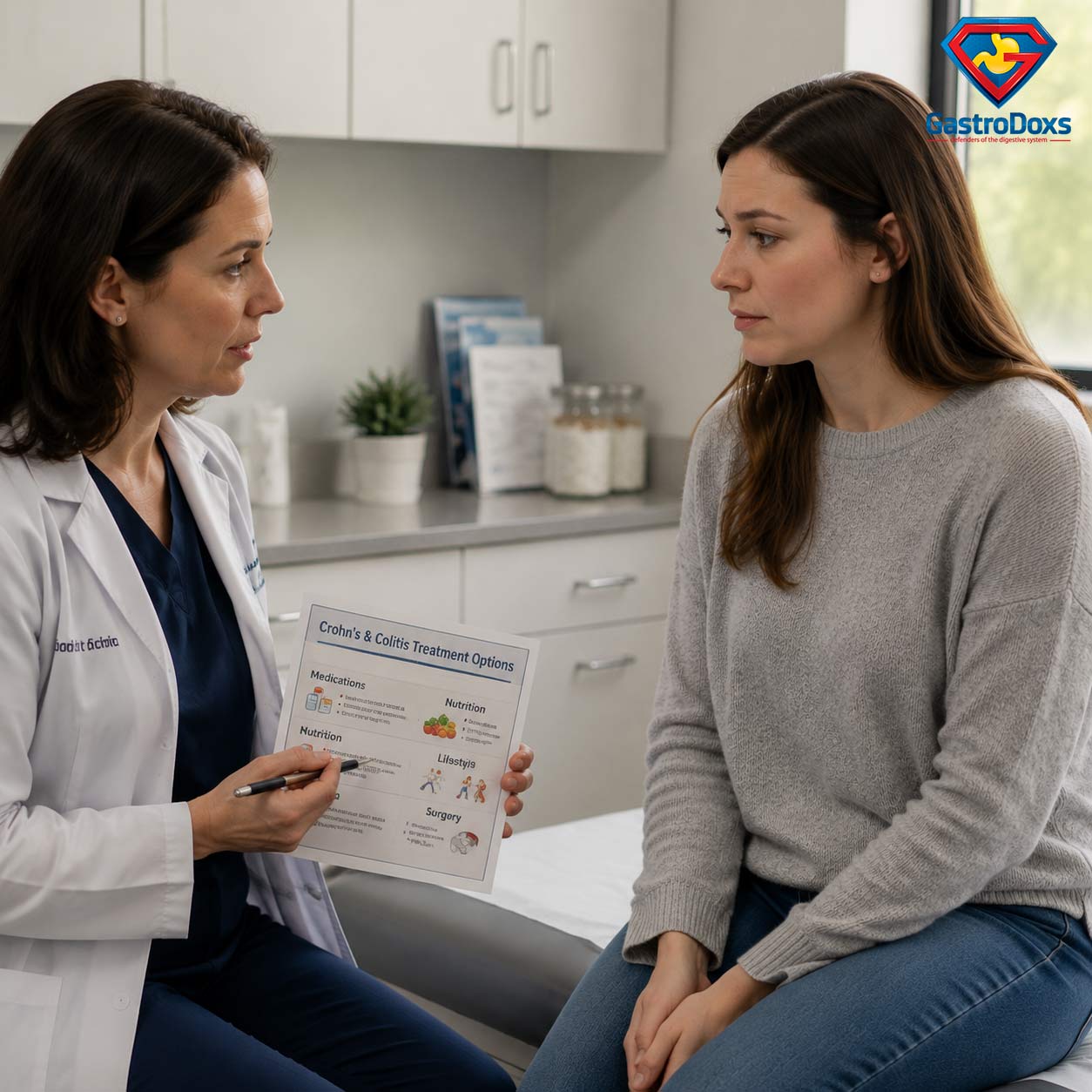
Treatment is matched to disease behavior, objective inflammation, and the patient's daily life.
The goal includes steroid-free symptom control and objective improvement on biomarkers, endoscopy, or imaging rather than symptom relief alone.
Biologics and small molecules are compared according to disease severity, prior treatment, safety, convenience, pregnancy plans, and insurance.
Strictures, fistulas, abscesses, perianal disease, anemia, malnutrition, and cancer-surveillance needs are integrated into treatment planning.
Vaccines, infection screening, bone health, nutrition deficiencies, smoking, mental health, and medication monitoring are addressed alongside inflammation.
A structured IBD visit designed around prior response and the next treatment decision.
Provide diagnosis date, colon distribution, hospitalizations, steroid exposure, medicines tried, side effects, and reasons each therapy was stopped.
Bring colonoscopy, pathology, CT or MR enterography, stool calprotectin, blood tests, operative notes, and vaccination records.
The clinician reviews induction and maintenance choices, expected onset, safety screening, monitoring, administration, and insurance pathway.
Your plan defines symptom checkpoints, laboratory and stool testing, endoscopic reassessment, and when treatment should be optimized or changed.
Your guardians. GastroDoxs GutGuardians™ is our team of gastroenterologists board-certified by the American Board of Internal Medicine (ABIM) - a physician-led defense force of specialists, systems, and solution pathways working together to protect, detect, solve, and defend your digestive health through expert GI evaluation, advanced diagnostic screening, and endoscopic evaluation - commanded from your first concern to your last follow-up, and every critical stage in between.
Your rescue plan. When your diagnosis is confirmed, GastroDoxs GutRescue Mission™ deploys at full force - a gastroenterologist-led intervention plan delivering advanced colonoscopy, upper endoscopy, capsule endoscopy, and precision biologic and medication management across the full range of digestive conditions and complex GI emergencies - fighting for you with everything we have.
A specialist review is useful when inflammation remains active or the next therapy is unclear.
Frequent prednisone or budesonide use suggests the maintenance plan is not achieving durable steroid-free control.
Patients can compare candidacy, safety screening, administration, expected onset, monitoring, and insurance requirements.
Ongoing pain or diarrhea with controlled inflammation may require evaluation for IBS overlap, bile acid diarrhea, infection, or structural disease.
Strictures, abscesses, fistulas, severe bleeding, dysplasia, or refractory disease may require coordinated colorectal-surgery input.
GastroDoxs provides individualized Crohn's colitis treatment, advanced-therapy planning, objective monitoring, nutrition support, complication evaluation, and coordinated surgical referral.






Crohn's colitis consultation and ongoing IBD care are available in Houston, Cypress, Katy, Jersey Village, and Brookshire. Bring colonoscopy, pathology, imaging, laboratory, stool, medicine, and insurance records.
Effective options include biologics, targeted small molecules, selected immunomodulators, short-term corticosteroids for induction, nutrition support, and surgery for complications. The best choice depends on disease severity and phenotype.
Common classes include corticosteroids for short-term flare control, anti-TNF agents, anti-integrin therapy, interleukin-targeted biologics, JAK inhibitors, and selected immunomodulators. Treatment is individualized.
Biologics may be appropriate for moderate-to-severe disease, high-risk features, steroid dependence, fistulizing disease, or inadequate response to other therapy. Infection screening and insurance authorization are required.
Surgery is considered for obstruction, abscess, fistula, perforation, uncontrolled bleeding, dysplasia or cancer, or disease that remains uncontrolled despite appropriate medical therapy.
Yes. Most patients are treated medically, and surgery is reserved for complications or refractory disease. Surgery can treat a diseased segment but does not cure Crohn's disease.
The plan is based on colonoscopy and pathology, disease extent, stricturing or penetrating behavior, perianal disease, biomarkers, prior medicines, infection risk, pregnancy goals, comorbidities, and patient preference.
Expect safety screening, vaccine review, baseline blood tests, discussion of how the therapy is given, expected onset, side effects, monitoring, and a plan for objective reassessment.
Some symptoms improve within days to weeks, while biologic or small-molecule response may take several weeks. Objective healing takes longer and should be assessed separately from early symptom change.
Benefits include steroid-free remission, mucosal healing, fewer hospitalizations, and complication prevention. Risks vary by drug and may include infection, liver or blood abnormalities, infusion or injection reactions, and rare serious events.
Nutrition should maintain adequate calories, protein, hydration, and micronutrients. During flares, texture may be adjusted to tolerance, but no universal diet replaces inflammation treatment.
Coverage depends on plan rules and often requires prior authorization, medical-necessity documentation, and use of an approved infusion center or specialty pharmacy. Staff can assist with the process.
Yes. Many patients achieve clinical and endoscopic remission. Maintenance therapy and monitoring are usually needed because stopping effective treatment can increase relapse risk.
Seek specialist care for persistent diarrhea, blood, anemia, weight loss, steroid dependence, recurrent flares, perianal disease, abnormal inflammatory markers, or treatment side effects. Severe symptoms require urgent care.
GastroDoxs provides IBD treatment across its practice locations. Bring full colonoscopy, pathology, imaging, medicine, laboratory, and insurance records for the most useful consultation.
Schedule online or call the practice. Send prior IBD records before the appointment so the visit can focus on the next treatment decision rather than reconstructing the diagnosis.
Get an individualized plan for advanced therapy, steroid-free remission, objective monitoring, nutrition, complication prevention, insurance coordination, and long-term IBD care.



