Biopsy-Proven Active Disease
Patients with ongoing watery diarrhea can review evidence-based induction therapy and symptom support.

 Medically Reviewed by
Dr. Bharat Pothuri, MD, FACG
| Updated 07-27-2026
Collagenous colitis treatment usually begins with medication and trigger review, hydration support, and budesonide when active microscopic inflammation is confirmed. GastroDoxs builds a plan for remission and relapse prevention.
Collagenous colitis can cause severe watery diarrhea even when the colon looks normal during colonoscopy. GastroDoxs GutRescue Mission™ helps patients connect the biopsy diagnosis with medication review, budesonide treatment, hydration and nutrition support, and a plan for recurrence after remission.
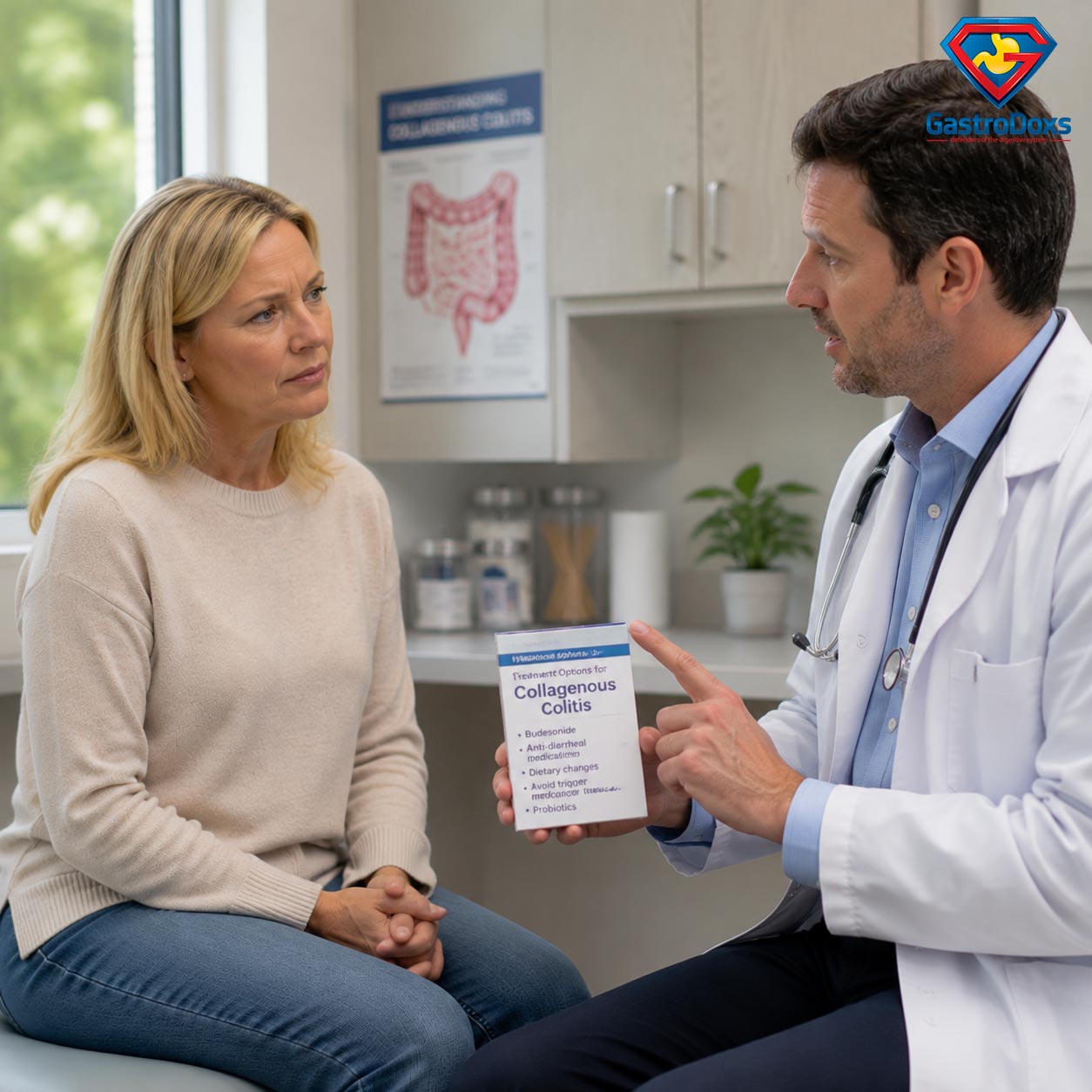
The biopsy diagnosis is translated into symptom control, trigger review, and relapse prevention.
We review whether biopsies from appropriate colon segments support collagenous colitis and whether infection or another diarrhea cause was excluded.
Treatment is designed to achieve control with limited systemic steroid exposure and a clear approach if symptoms recur.
NSAIDs, acid suppressants, antidepressants, metformin, supplements, and bile acid diarrhea are considered in the full clinical context.
The plan addresses nighttime stools, urgency, leakage, weight change, travel, work, and the practical burden of chronic diarrhea.
A treatment-focused pathway based on biopsy quality, current diarrhea, and previous response.
Upload complete procedure and biopsy reports, including which colon segments were sampled and the pathologist's description.
Record stool frequency, nighttime symptoms, urgency, weight, medicines, antibiotics, smoking, and prior treatment response.
The clinician reviews budesonide, antidiarrheals, bile acid therapy, dietary support, hydration, and trigger changes.
You leave with a taper or maintenance strategy, symptom thresholds, and a plan for laboratory or repeat biopsy reassessment when appropriate.
Your guardians. GastroDoxs GutGuardians™ is our team of gastroenterologists board-certified by the American Board of Internal Medicine (ABIM) - a physician-led defense force of specialists, systems, and solution pathways working together to protect, detect, solve, and defend your digestive health through expert GI evaluation, advanced diagnostic screening, and endoscopic evaluation - commanded from your first concern to your last follow-up, and every critical stage in between.
Your rescue plan. When your diagnosis is confirmed, GastroDoxs GutRescue Mission™ deploys at full force - a gastroenterologist-led intervention plan delivering advanced colonoscopy, upper endoscopy, capsule endoscopy, and precision biologic and medication management across the full range of digestive conditions and complex GI emergencies - fighting for you with everything we have.
A visit is useful when watery diarrhea persists, relapses, or remains unexplained after a normal-looking colonoscopy.
Patients with ongoing watery diarrhea can review evidence-based induction therapy and symptom support.
Relapse may require retreatment, maintenance therapy, trigger reassessment, or evaluation for an overlapping diarrhea mechanism.
Microscopic colitis may have been missed when the lining looked normal but tissue samples were not obtained.
The care plan can explore the lowest effective therapy and uncommon steroid-sparing options when disease is refractory or recurrent.
GastroDoxs confirms the biopsy context, treats active microscopic inflammation, reviews medication and bile-acid contributors, and creates a practical plan for remission and relapse.






Microscopic colitis treatment is available in Houston, Cypress, Katy, Jersey Village, and Brookshire. Bring colonoscopy and pathology reports, stool tests, medicine lists, and previous treatment records.
Budesonide is the best-supported first-line treatment for active collagenous colitis. Other options may include antidiarrheals, bile acid binders, bismuth, medication changes, and rare advanced therapy for refractory disease.
Commonly used medicines include budesonide, loperamide for selected patients, bile acid binders when bile acid diarrhea is suspected, and occasionally bismuth. Treatment is individualized.
Some mild cases improve with trigger withdrawal and supportive therapy, but active biopsy-proven disease often responds best to budesonide. Systemic prednisone is generally avoided when budesonide can be used.
Long-term low-dose maintenance may be recommended for frequent relapse, steroid dependence, or symptoms that repeatedly return after induction. The lowest effective dose is preferred.
The plan is based on biopsy confirmation, symptom severity, dehydration, weight change, medicine exposure, bile acid diarrhea, celiac disease, prior response, comorbidities, and relapse history.
Diet should support hydration and nutrition while limiting clear personal triggers. Caffeine, alcohol, high-fat foods, lactose, or artificial sweeteners may worsen symptoms in some patients, but broad permanent restriction is not routinely required.
Expect a medication and trigger review, discussion of budesonide and symptom control, hydration planning, and a timeline for deciding whether treatment is working.
Many patients improve within days to several weeks on budesonide. The exact response depends on severity, adherence, overlapping diarrhea causes, and whether the diagnosis is correct.
Biologics are not routine first-line therapy but may be considered by specialists for severe refractory microscopic colitis that has not responded to better-supported options.
Colonoscopy with biopsies is recommended when the diagnosis has not been confirmed, symptoms have changed, warning signs are present, or another colon disease needs exclusion. A normal visual exam without biopsies does not rule it out.
Budesonide has lower systemic exposure than prednisone, but prolonged use can still affect bones, eyes, glucose, adrenal function, or infection risk. Benefits and monitoring are individualized.
Yes. Relapse is common after successful treatment. Retreatment or maintenance therapy can be effective, and recurrence should prompt review for triggers or overlapping conditions.
Coverage depends on the medicine, formulation, plan, pharmacy, and authorization rules. Staff can help verify budesonide or advanced-therapy benefits.
GastroDoxs treats collagenous colitis across its practice locations. Bring complete biopsy reports because the pathology—not colon appearance alone—establishes the diagnosis.
Schedule online or call the practice and send colonoscopy, pathology, stool-test, medication, and prior-treatment records before the visit.
Get a clear plan for budesonide, symptom support, medication triggers, bile acid overlap, hydration, nutrition, and relapse prevention.