Adenoma found during colonoscopy
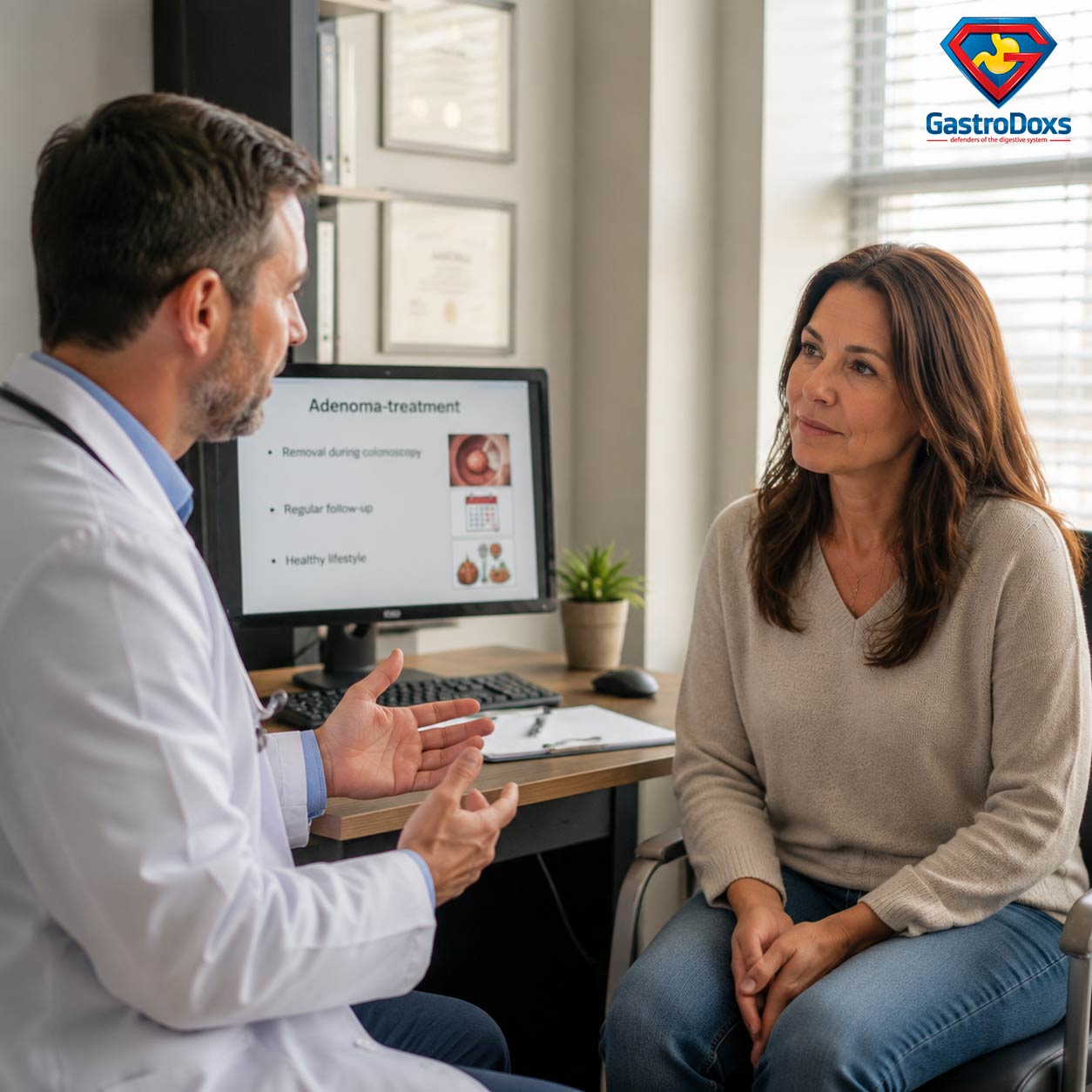
Colonoscopy is commonly used to remove many colon adenomas and send tissue to pathology. Complex lesions may need advanced removal or surgery.

 Medically Reviewed by
Dr. Bharat Pothuri, MD, FACG
| Updated July 17, 2026
Adenomas are growths that may become cancerous over time, especially when they are large, advanced, multiple, or incompletely removed. GastroDoxs GutRescue Mission™ helps patients understand colon polyp pathology, removal options, and follow-up timing.
Adenomas are gland-like growths that can form in the colon and other organs. GastroDoxs GutRescue Mission™ helps patients move from an adenoma finding to a clearer care plan by reviewing colonoscopy results, polyp size, pathology type, removal completeness, cancer-risk signals, and the timing of the next surveillance colonoscopy.
Digestive-focused decision support, records review, testing guidance, and clear next-step planning.
GastroDoxs reviews whether adenomas were removed completely, whether additional colonoscopy is needed, and whether advanced polyp removal should be considered.
The team explains why polyp type, size, number, dysplasia, and serrated features affect cancer risk and surveillance timing.
Adenoma care is about reducing future colon cancer risk through complete removal, appropriate intervals, and symptom awareness.
Patients receive guidance on what records to keep, when to return, and when family history or multiple polyps changes the plan.
A simple visit path for treatment-stage decision making.
Share the colonoscopy report, pathology report, photos, and any recommendation from the prior provider.
Your provider reviews polyp size, number, location, histology, dysplasia, and whether removal was complete.
The next step may include repeat colonoscopy, advanced polyp removal, routine surveillance, or surgical referral for selected complex lesions.
You leave with a clearer interval plan and instructions on symptoms or report findings that should not be ignored.
Your guardians. GastroDoxs GutGuardians™ is our team of gastroenterologists board-certified by the American Board of Internal Medicine (ABIM) - a physician-led defense force of specialists, systems, and solution pathways working together to protect, detect, solve, and defend your digestive health through expert GI evaluation, advanced diagnostic screening, and endoscopic evaluation - commanded from your first concern to your last follow-up, and every critical stage in between.
Your rescue plan. When your diagnosis is confirmed, GastroDoxs GutRescue Mission™ deploys at full force - a gastroenterologist-led intervention plan delivering advanced colonoscopy, upper endoscopy, capsule endoscopy, and precision biologic and medication management across the full range of digestive conditions and complex GI emergencies - fighting for you with everything we have.
Schedule a GI-focused visit when symptoms, reports, or prior findings need clearer next steps.
Colonoscopy is commonly used to remove many colon adenomas and send tissue to pathology. Complex lesions may need advanced removal or surgery.
Adenoma treatment depends on symptoms, test results, risk factors, and prior records. GastroDoxs can help review digestive findings, explain next steps, and coordinate care when needed.
Adenoma treatment depends on symptoms, test results, risk factors, and prior records. GastroDoxs can help review digestive findings, explain next steps, and coordinate care when needed.
Adenoma treatment depends on symptoms, test results, risk factors, and prior records. GastroDoxs can help review digestive findings, explain next steps, and coordinate care when needed.
Adenoma treatment depends on symptoms, test results, risk factors, and prior records. GastroDoxs can help review digestive findings, explain next steps, and coordinate care when needed.
Adenoma treatment depends on symptoms, test results, risk factors, and prior records. GastroDoxs can help review digestive findings, explain next steps, and coordinate care when needed.
GastroDoxs provides colon polyp and adenoma care through colonoscopy planning, polyp removal review, pathology interpretation, and surveillance recommendations.






Adenoma follow-up helps reduce colon cancer risk by matching removal history and pathology features with the correct surveillance plan.
Patients with colon adenoma findings can request GastroDoxs care for colonoscopy review, polyp removal planning, pathology interpretation, and surveillance timing.
A gastroenterologist usually evaluates and removes colon adenomas during colonoscopy. Large or complex adenomas may need advanced endoscopic removal or surgical referral.
Many adenomas do not require emergency treatment, but they should not be ignored. Timing depends on size, pathology, dysplasia, symptoms, and removal completeness.
Colonoscopy is commonly used to remove many colon adenomas and send tissue to pathology. Complex lesions may need advanced removal or surgery.
Some adenomas can become cancer over time, especially advanced, large, villous, serrated, dysplastic, or multiple adenomas. Removal and surveillance reduce risk.
A gastroenterologist usually evaluates and removes colon adenomas during colonoscopy. Large or complex adenomas may need advanced endoscopic removal or surgical referral.
Care depends on adenoma size and complexity. GastroDoxs can review reports and coordinate advanced endoscopic removal or referral when needed.
Colonoscopy is commonly used to remove many colon adenomas and send tissue to pathology. Complex lesions may need advanced removal or surgery.
After an adenoma is found, the next step is confirming pathology, whether removal was complete, and when follow-up colonoscopy should occur.
Removed adenomas can recur or new adenomas can form. Surveillance colonoscopy timing depends on the number, size, type, and pathology findings.
Surgery is usually reserved for adenomas that cannot be removed safely by colonoscopy, show invasive cancer, or have high-risk features.
Treatment planning reviews polyp number, size, location, histology, dysplasia, removal completeness, family history, and the safest surveillance interval.
Some adenomas can become cancer over time, especially advanced, large, villous, serrated, dysplastic, or multiple adenomas. Removal and surveillance reduce risk.
Many adenomas do not require emergency treatment, but they should not be ignored. Timing depends on size, pathology, dysplasia, symptoms, and removal completeness.
Follow-up care usually includes pathology review and surveillance colonoscopy at an interval based on adenoma risk features and prior results.
Healthy weight, regular activity, not smoking, limiting alcohol, and following colonoscopy surveillance may help reduce future risk, but they do not replace removal.
Seek prompt care for rectal bleeding, black stool, unexplained anemia, persistent bowel changes, or weight loss. Take the next step with GastroDoxs for GI-focused evaluation, records review, treatment planning, and coordinated follow-up.



